Tuesday, January 21, 2014

Claudio Abbado

The problem with musical tastes that are, as I keep saying, broad rather than deep is that when someone as significant and much-loved as Claudio Abbado dies, I can't add useful insight. Yes, I really like such-and-such a recording but I'm not qualified to explain to you why it was maestro Abbado's insert conducting quality here that lifted it to the realms of the transcendent. I can tell you that I was once transfixed when I turned on the radio and heard him conducting the slow movement of Mahler's 6th. I can tell you that the first proper Abbado recording I bought was a Decca selection of Hindemith on which he led the LSO in the Symphonic Metamorphoses, and I'm really fond of that album. I can even tell you that the first non-proper Abbado recording I owned was an excerpt from his recording of Debussy's Pelleas et Melisande on a Classic CD cover disc (issue 23, the one I keep going on about), though I'll admit that didn't particularly catch my ear. Also, his was the only Beethoven 9 I had for a long time. And the most recent of his recordings that I own seems to be his work with Isabelle Faust on the Berg and Beethoven violin concertos.
He will be missed. I suspect this will be the only obituary/appreciation/inane rambling that gives you Abbado's Spitting Image puppet though.

Thursday, January 16, 2014

Top 23 of 2013 (supplemental)

Supplemental, that is, to my list on Music is Good. Yes, go read the thing there. But here is the list without pictures or commentary (it's ordered more-or-less thematically rather than by "quality"):

Petitgirard: The Little Prince. Laurent Petitgirard conducting (Naxos)
“Spheres". Daniel Hope (Deutsche Grammophon)
“Violin Lullabies”. Rachel Barton Pine (Cedille)
“Wagner”. Jonas Kaufmann (Decca)
Mahler: Orchestral Songs. Christian Gerhaher (Sony)
Eisler: Lieder. Matthias Goerne (Harmonia Mundi)
Dvořák: Stabat Mater. Philippe Herreweghe conducting (Phi)
“Songs of Olden Times”. Heinavanker (Harmonia Mundi)
Monteverdi: Heaven and Earth. Robert King (Vivat)
“Io vidi in terra”. José Lemos (Sono Luminus)
Telemann: Hoffnung des Wiedersehens. Dorothee Mields (DHM)
“Bach Re-invented”. Absolute Ensemble/Kristjan Järvi (Sony)
Cassuto: Return to the Future. Álvaro Cassuto conducting (Naxos)
Schafer: String quartets nos.8-12. Quatuor Molinari (Atma)
“Thrum”. Minneapolis Guitar Quartet (Innova)
“Full Power”. Trombone Unit Hannover (Genuin)
“Transitions”. Olga Pashchenko (Fuga Libera)
Mompou: Piano music. Arcadi Volodos (Sony)
Pärt: Piano music. Jeroen van Veen (Brilliant)
“Variations on a Theme by Scarlatti”. Matan Porat (Mirare)
Roth: Sometime I Sing. Mark Padmore, Morgan Szymanski (Signum)
Nørgård: Songs from Evening Land. Helene Gjerris (Dacapo)
Stravinsky, Borodin, Tchaikovsky, Mussorgsky. Mythos (Orchid) 

So, in lieu of examining the trends of the now-defunct Nereffid's Guide Awards, let me analyse this list instead!
My purchases during the year were, as usual, mostly via eMusic, which with my cheap old subscriptions is a real godsend. But 6 of the Top 23 came from elsewhere - all major labels. In fact, I bought only 2 other new albums from outside eMusic. Well, I suppose if I'm willing to pay a higher price for something, that means it's going to be less of a risk and it will be something I expect to like a lot. Interestingly, the 6 majors on the list were represented as: 2 from Universal (1 Decca, 1 DG) and 4 from Sony (including the DHM label). I hadn't really considered Sony a significant releaser of Stuff I Like until now.
One thing that pleases me about my Top 23 (yes, aside from the fact that 23 is a prime number) is the variety. I made no deliberate effort to be representative—no thoughts of "well, I have to include this because I don't have anything else from that genre". That said, there's no "difficult modern music" to speak of, and the classical mainstream is underrepresented compared with the world of new releases generally. But the former I tend not to like, and the latter I tend to already own some recording of and so I'm more keen to buy music I haven't heard.
What's most heartening is that almost none of the albums on the list came recommended to me by a review (IIRC, only the Trombone Unit Hannover and Arcadi Volodos releases). For many years I've read lots of reviews and used the judgement of others to point me in the right direction—not that I slavishly follow the tastes of the majority, but I found it a very useful way of drawing my attention to things I reckoned I'd like. Before that, too, there was a lot of filling up the repertoire in my collection (composer X is a "great composer", so I should have his symphonies), which gave me a lot of music that was worthy but not necessarily something I loved; the collector in me is adamant that this wasn't a huge waste of time or money because (a) it helped me establish my actual tastes and (b) I know my tastes do and will change over the years. Also, back before the Download Age and the ability to sample before buying, I was rather more hit-and-miss with things I thought I might like. All of this is to say that I've had multiple excuses for not having the courage to choose albums based solely on my own desires rather than the encouragement of others, but I've finally ditched those excuses and, huzzah!, it turns out I actually know what I'm doing after all.

NGA RIP

The 2013 Nereffid's Guide Awards should be coming up around now, shouldn't they? Alas, there will be no more Nereffid's Guide Awards. Well, I say "alas" but that's in the general sense, the sense that it's a pity that after six years an entertaining and, to some small number of people at least, useful thing should come to an end. In the specific sense, the 2013 awards, I'm mostly relieved to be shut of it, which sounds a bit harsh but bear with me. 
There were a few reasons for the awards' demise. One was financial: the review magazines cost a bit of money over the course of a year, and cutbacks needed to be made. Another was one I referred to a while back: I've stopped waiting for reviews to decide what albums to get, instead looking for brand-new releases. That, inevitably, eliminated the immediate (as opposed to archival) value of getting any magazines, which made the decision to stop getting them a lot easier. The third, and not an insignificant one, was that collating all those reviews was bloody hard work. True, hobbies that require little effort aren't much fun, but I was finding that the work being put in wasn't balanced by the pleasure obtained at seeing it done.
Also, let's be honest, site traffic shows that I'm not going to be upsetting thousands of people by giving up. There was some buzz with it back in the eMusic days but that was a while ago, and I never did it for the publicity anyway. I'm sure that someone could carve out a nice successful niche with a web site that collates classical reviews (Classical Digest exists but doesn't have new material) and presents awards at the end of the year. But that person isn't me. (Though if you know someone with technical expertise and money, call me...)

Monday, August 5, 2013

Thoughts on "Transitions".

I had this great idea for a Music Is Good article in which I would combine a review of Olga Pashchenko's wonderful debut album "Transitions" with a discussion of how it reflected various preconceptions that could be entertained about classical music. Things that I had "learned and unlearned". But it soon struck me that the reader might never have had such preconceptions or even been aware of their existence, and hence I'd have a much harder case to make. So instead I can write about it here, where I can put in any old shite and not feel like I'm letting anyone down.
Such thoughts of preconceptions were also encouraged by my by-the-way noticing that the EMI compilation "The Classic Experience" was released in 1988 and I thus can say that classical music has been a feature of my listening habits for an even quarter-century. (I can't actually remember the exact circumstances of that album appearing; I think we got it for my father for his birthday or something. I can't even say for certain that this was the first classical album I listened to with any regularity. I might have had a few other things before it. Screw it, this is my memoir, and I get to say what's an acceptable level of fact).
It'd be a nice coincidence if Olga Pashchenko were herself a quarter-century old, but she's a little older than that. You can have a listen to the album and read the sleeve notes on the relevant page at Outhere Music, so all we'll say by summary here is that it's a fortepiano recital featuring music by Dussek, Beethoven, and Mendelssohn. Come to think of it, if you have good enough eyesight you could have got that from the cover image above. (See? I can put in any old shite!).
Now here's the preconceptions bit.
1. Classical music can be divided neatly into periods.
OK, this one wasn't a preconception I started out with, in as much as back in 1988 it was all just "classical music" and I had no real notion of what the chronology of it was. But I soon learned that there were these eras: Medieval, Renaissance, Baroque, Classical, Romantic, and... well, it got a bit tricky then because Modern included music written nearly a century earlier as well as much more recent music that didn't sound as modern as some of the older modern stuff. Also you could have Early Music which sometimes included Baroque. This sort of thing is generally very helpful for organising your thoughts, but—as the current chapter of A History of Classical Music will show if I ever get around to finishing it—there are grey areas. Which is where Olga Pashchenko finally comes in, because "Transitions" is about the move from Classical to Romantic. Beethoven's op.33 Bagatelles are from 1802 but if anything they mark a transition from Baroque to Romantic; conceptually they're the sort of character pieces a Couperin or Schumann might have written. And the other pieces... well, you can spend ages attempting to identify Classical versus Romantic notions in all of these works, but ultimately that's just an academic exercise. The great thing about being a music listener today is that we can listen to anything whenever we like; "new" music is like as not several centuries old. So these classical eras are useful guides but we can also say "so what?" Here's some Dufay, here's some Dutilleux...
2. Piano music belongs on a grand piano.
Olga Pashchenko here plays on two fortepianos, an instrument that in 1988 I was unaware of. I remember one of the first issues of Classic CD I read (circa 1993 for the sake of argument) had something about Melvyn Tan in it (also an anecdote about someone being told that Melvyn Tan was one of the top fortepianists in the world, and wondering who the other 39 were). So Mozart and Beethoven were played on a modern grand and that was all I knew about it. I don't keep too close an eye on these things but Beethoven on fortepiano seems to raise few eyebrows these days; in a 2010 review of one of Ronald Brautigam's sonata discs, Christopher Brodersen in Fanfare said "Although not the first pianist to use a period instrument to record the complete Beethoven sonatas (that honor belongs to Malcolm Binns on L’Oiseau-Lyre, circa 1977), Brautigam is the first to approach the music in such a way that the choice of a period instrument is no longer a novelty, or even the main attraction", so I guess that's about where we stand now. But, again going back to Classic CD, the whole notion of "historically informed practice" came as something of a surprise to me; I think the first time I paid serious attention to the idea was with Gardiner's Beethoven 9 (the "Froh, froh" section was on a cover disc), which would have been 1995 I suppose. Obviously period practice had been around for quite a while at this stage, but it was news to me, implying that it certainly wasn't the norm. These days you get complaints that Nobody's Allowed to play anything the "old-fashioned" way; if you try to conduct a Mozart symphony with more than forty players you'll be run out of town. Or something. True, there are some who will insist that Beethoven was most certainly writing for a modern grand (I know!) and thus should only be performed on same. To which all one can really say is "pfft". The music Olga Pashchenko plays here sounds perfectly at home on the instruments she's using.
3. Mendelssohn was a middle-class sentimentalist.
I'm not actually sure of the extent to which this idea was prevalent back in 1988 or subsequently, but I certainly picked it up from somewhere other than my own mind. Maybe it's just one of those myths that I only read in the context of being exploded; maybe in 1988 everyone knew Mendelssohn wasn't some overly genteel Victorian but still had to keep pointing out that he wasn't, sort of like nobody believes Vivaldi wrote the same concerto 400 times but there are people who still like to remind us that he didn't. Anyway, though I don't think I myself ever specifically dismissed Mendelssohn on these grounds, I never felt any particular need to explore his music; this was mostly because I'd group him with Brahms and Schumann as 19th-century composers I wasn't that keen on, but there was certainly some sense of his bad reputation preceding him. Too many wordless songs, doves' wings, and fairies. Anyway, listening to the Variations serieuses, especially on a fortepiano, should set things right. Aside: We were watching the recent Proms performance of the Beethoven 7 last night and the presenter did the usual thing of quoting Wagner's comment about it being the "apotheosis of the dance", which got me thinking about how there are certain "stock quotes" for classical music (yes, including Stravinsky's dig at Vivaldi). Yes, the Wagner quote is a nice one to throw in approvingly, but can we also pause and consider the fact that Wagner also said that Mendelssohn could never be a great composer on the simple grounds that he was a Jew, and if someone is capable of making that sort of asinine statement about music, why should we take him seriously as a commentator on the subject? (Insert smiley here to placate outraged Wagnerians).
4. Obscure composers have been forgotten for a reason.
Ah yes, the Canon. I do indeed believe that there's a canon of great composers and great works, but I also believe this canon to be the outcome of a democratic, if nebulous, election. Who are the great composers? Those who stand a reasonable chance of being mentioned when someone is asked "who are the great composers?" Certainly there are some—Bach, Mozart, Beethoven—who seem to have had a particular ability to appeal to a huge proportion of listeners, but the fact that we all have favourite composers that tend not to show up on these lists of the greats shows how ultimately futile such lists are. So Beethoven is definitely a Great Composer, and Jan Ladislav Dussek definitely isn't. And we can say this authoritatively because...? Recently Jerry Coyne asked (in the context of the recent JK Rowling Pseudonym Kerfuffle), "Imagine that Beethoven had never written his Fifth Symphony. But then, a few years ago, someone finds the score of that piece in a stack of old papers—written by someone other than Beethoven, say, one Gustav Biederstücker.  What would happen?... It should be recognized as a lost masterpiece. But it wouldn’t, because it was written by Biederstücker and not Beethoven. It would be ignored." Well, that got me thinking that if Beethoven hadn't written his Fifth Symphony then this would surely have had a knock-on effect in terms of Beethoven's posthumous reputation—one less symphony to intimidate Brahms or for Berlioz and Liszt to idolise; only 8 Beethoven symphonies and thus no "curse" associated with a 9th; and of course no "V for Victory" motto; different clichéd music required for certain situations... butterfly wings! butterfly wings! It's conceivable that the absence of Beethoven's Fifth from history would mean that the very definition of a "masterpiece" would be changed, on the grounds that this work of music itself laid the foundation for the things that became regarded as "great music" in the later 19th century. So we can say Dussek wasn't "as good" a composer as Beethoven but perhaps to some extent this is because "Beethoven" is actually part of the definition of a good composer. History written by the victors etc. (Which also reminds me tangentially of Joseph Heller's "Picture This": Homer couldn't have been the author of both the Iliad and the Odyssey because nobody could be that great an author... unless he was a genius on the order of Homer.). Hey, this also reminds me of something I wrote a few years ago about teaching newcomers to classical music using single-composer compilation albums: "The other controversial aspect is that your Bachs and Beethovens get equal time to your Telemanns and Hummels. But at least it offers a broader perspective on the world of music. It's more of a "listen without prejudice" approach. Possibly your pupil might mentally rewrite history if they're not, as it were, obliged to consider composer A to be more worthy than composer B." So let's put ourselves in the mind of the Fictional Total Novice who's listened to Olga Pashchenko's "Transitions" and heard music by Dussek, Beethoven, and Mendelssohn. They've never heard of any of these composers or their music. And we ask: which one of these was subsequently declared a godlike genius? Presumably they would reserve judgement until they'd heard more of each man's work. And then...?
5. Oh yes, one last preconception.
This one I thought was deader'n a dodo, but actually I'm not sure: That the major labels are your best option. Back in 1988, Naxos celebrated its 1st birthday; Chandos and Hyperion were less than a decade old. The vast majority of albums I bought before about 10 years ago were on major labels. But now it's quite the reverse. We see it in the Nereffid's Guide Awards each year; the majors (now, of course, down to 3) do win some awards but it's the indies who make by far the best showing. But I did a double-take recently when I read this in the digital magazine thingy Gramophone produced for its latest awards: "And once again, the difference between major company and independent is less discernible" (drawing attention to Beethoven symphonies on Glossa versus "1612 Vespers" on Decca). I'd say the mere existence of that Decca recording is newsworthy, certainly, but it's an outlier for the majors, who by the way got 17 out of the 66 nominations. Seems like the "difference" between majors and indies is that indies produce three-quarters of the best music. Now let me wheel around with a horrible journalistic manoeuvre and say something like "I don't know if Olga Paschenko's album will appear in next year's Gramophone Awards, but..."

And that's what I think about when I listen to "Transitions", the new album by young Russian pianist Olga Pashchenko, out now on the Fuga Libera label.

Saturday, June 29, 2013

Newly heard: R Murray Schafer, etc

Pick of the last fortnight is the Molinari Quartet's second collection of string quartets by Canadian composer R Murray Schafer, whose 80th birthday is in a couple of weeks (ATMA). I remember several years back on eMusic people were urging me to listen to the first set (nos.1-7) but that was one of many things I never got round to. Now here's nos.8-12, written between 2000 and 2012. They're works with immediate appeal, and each quite different: 8 has some orientalisms in it; 9 makes use of a recording of a girl's voice singing an innocent tune, along with occasional interruptions from the sound of children playing; and the evocative 10, subtitled "Winter Birds", includes a brief recitation by the composer describing the snowy world of his farm in Ontario.

Rachel Barton Pine's "Violin Lullabies" (Cedille) could, in other hands, have been Classical Diabetes, but this is a genuinely lovely album. Her tone avoids the cloying sweetness we might associate with these sorts of pieces, and she makes use of various types of mute for half the works. And it's not just the usual suspects here - it opens with the Brahms but before we get to Gershwin's "Summertime" we hear music from Ysaye, Rebikov, Beach, Schwab, and Respighi. So it manages to be both a good "starter" album for parents and a bit of a byway exploration for us collector types.

Vox Luminis's new album (Ricercar) focuses on the music used for the funeral of Queen Mary, which was composed not just by Purcell but also by James Paisible, Thomas Tollett, and Thomas Morley; there are also other funeral works by Thomas Weelkes, Thomas Tomkins, and Purcell again (his Funeral Sentences were apparently not written for Queen Mary). This is music I know through the classic Winchester Cathedral recording, but obviously Vox Luminis's 16 voices bring a very different sound, which I must say I prefer.

Kimmo Hakola's guitar concerto takes medieval Spain, and specifically the Sephardic Jews, as its inspiration. If, like me, you already know his clarinet concerto and enjoy its klezmer influences, then this is probably recommendation enough to get the new recording from Timo Korhonen with the Oulu Symphony Orchestra under Santtu-Matias Rouvali (Ondine). For me, Hakola's work is the main event of the album, but there's also two substantial (at times, huge) pieces by Toshio Hosokawa, both of which are inspired in some way by the lotus; Blossoming II is for orchestra, while Voyage IX (Awakening) is a guitar concerto.

I'm gradually building up a picture of Erwin Schulhoff's music, and the second volume of piano works (mostly from the 1920s) on Grand Piano from Caroline Weichert reveals the influence of jazz and other popular music. It's by and large rather light stuff, though a great "whut the...?" moment comes with the Fünf Pittoresken of 1919; after a Foxtrot and a Ragtime, we're treated to a piece called In Futurum, which consists entirely of rests. An amiable disc, and it sounds well too. Grand Piano seems to have found a good niche for itself.

Andreas Staier's new album of harpsichord music is - well, that should be recommendation enough for a lot of people.  Anyway, it's called "Pour passer la Mélancolie" (Harmonia Mundi) and while it's not exactly a laff riot the music is far too interesting for us to dismiss it as generically gloomy. I find harpsichord recitals are heavily dependent on the sound of the instrument, and this one brings everything to life. The album grew on me each time I returned to it.

Finally, a special mention to the splendid cover disc on the most recent BBC Music Magazine, a 1973 Proms performance of Holst's Planets from Adrian Boult and the BBCSO. It was a Boult recording of the work that first introduced me to classical music so there's a wee bit of nostalgia attached, but it's a marvellous performance anyway. Plus it's accompanied by a more recent Proms performance, Paul Lewis in Beethoven's 1st piano concerto.

Friday, June 21, 2013

Every little helps...

So there's this online radio thing from Tesco called Blinkbox, which is, apparently, "the easiest way to listen to the music you already love, or discover new favourites - all for free". I'm not sure what I did to earn an email from them alerting me to the existence of Blinkbox but, hey, when you get an unsolicited email the first thing you should do is click on the link, right?
Well it looks like your standard online radio thing, so I decided to check out the Classical stations. A bunch of stuff there, though with prominence given to "Classical Crossover" and "Now Classical", which is to say excerpts from "Now that's what I call classical". Hmm, am I in their demographic? Ah, but there's one station called "Contemporary Classical" so I'll give that a go. 
I do like Janacek's Sinfonietta all right, but in what sense does music written by someone who died in 1928 count as "contemporary"? Also the absence of a credit for the performers is a black mark.
On screen there's a bunch of album covers and if I mouse over one I get the chance to create a station based on this album. So I try it with "The John Adams Earbox" and get... an excerpt from Berg's Wozzeck. Ah. Then something by Stockhausen. Then Britten's Simple Symphony. And now I'm listening to a bit of Mothertongue by Nico Muhly who at least has the virtue of being alive, even if this doesn't sound much like John Adams.
Shall we try another station? Oh, lets! How about "Classical Essentials"?
First up: "Spring" from The Four Seasons.

Monday, June 10, 2013

Newly heard: Ghetto Strings, etc.

Pianist Lara Downes's new album on the Steinway & Sons label is called "Exile's Cafe" and features music by 13 composers who were emigrés at some point in their lives. Along with Bartók, Chopin, Prokofiev, Martinu, Stravinsky, Rachmaninov, Weil, Korngold, and Milhaud we get less well known figures like William Grant Still, Paul Bowles, Michael Sahl, and Mohammed Fairouz. Actually I'm not sure if Still was ever an exile, but the music we hear is an extract from "Africa" so I guess that counts. So the album's a good mix of the familiar and unfamiliar (in my case, almost all of it was unfamiliar). As you might expect given the theme there's a general melancholic atmosphere, though in fact not all of the pieces were composed in exile (Korngold's Piano sonata no.2, for instance, of which we hear the first movement, was written when he was in his early teens). OK, so the concept might not be strictly rock-solid, but the project is definitely a success.

More Martinů in the form of the first volume of Toccata's series of Early orchestral works. The earliest piece is Village Feast from 1907 (he was 16), the latest from 22 years later (Prélude en forme de Scherzo) so I guess this is a fairly wide definition of "early" (all Mozart and Schubert works are "early" in that case!). These are all first recordings, from Ian Hobson and the Sinfonia Varsovia. I'm no Martinů expert but I'm comfortable with describing these works as "sounds like early Martinů", and there's plenty to enjoy. Indeed, if this were your first introduction to Martinů you'd probably be quite happy to then explore further.

From Le Miroir de Musique and Baptiste Romain comes "The Birth of the Violin" (Ricercar), a selection of music from the 15th and 16th centuries, ranging from Obrecht and Josquin to Willaert and Bassano. Essentially in most of the works the violin shows up as a substitute for a voice in a motet, madrigal or other vocal work, though there's also some dedicated instrumental music. There's an academic intent here, obviously, and the album may very well show up in my History of Classical Music through Recordings, but it's not merely academic, and the journey is a fascinating one.

And onwards to Monteverdi and The Sixteen's third and final disc of excerpts from Selva morale e spirituale. I suppose little needs to be said about this group's reliability in music of the period, and the previous volumes have had good enough reviews that when the dust settles this seems likely to be many people's top choice for the work. My innocent ears have no complaints, anyway, and I guess I'll have to go get the other two volumes now, won't I?


Finally, the Minneapolis Guitar Quartet give us four works on their new Innova release, "Thrum". The title piece is a laid-back set of three movements from David Evan Thomas - all four composers on the album were unfamiliar to me. Van Stiefel's Cinema Castenada is intended to evoke a scene of the performers gathered round a campfire, and it does have a meandering, improvisatory feel, with some vocalising for good measure. There are apparently lots of musical references in there that I haven't really picked up on. Gao Hong joins the quartet on pipa for his Guangxi Impressions, so you won't be surprised that it sounds rather Chinese. These are all enjoyable works, though the highlight for me is the opening Ghetto Strings, in which Daniel Bernard Roumain depicts (consecutively) "Harlem", "Liberty City", "Motor City", and "Haiti"; there's plenty of folk/popular music styles in here and all very evocative.

Sunday, May 26, 2013

Newly heard: Russian accordions, and Spain rediscovered

In which the author attempts to revive the blog by posting briefly about the music he's been listening to over the past week.

When I was putting together my Top 20 of 2012 for Music is Good, I realised that part of the reason I didn't have a huge amount of 2012 releases to consider was that, because I based my purchases on magazine reviews, I was usually several months behind the times, and something I got "new" in, say, April had actually been released back in December. So, recently I said to myself, why don't I rely more on the New Releases list in IRR rather than waiting for reviews to come out, because actually a lot of the stuff I get, I get not because the review is good per se but simply because the review brings my attention to something that suits my tastes. The advice of reviewers tends to be useful mostly when considering repertoire choices. Thus, a New Era Dawns, and I look forward to being if not ahead of the curve, at least somewhere in the curve's vicinity. And hey, that means you might be too!

The Danish accordion duo Mythos have transcribed several Russian orchestral classics for their Orchid Classics release (link): Petrushka, In the Steppes of Central Asia, three bits from The Nutcracker, and Night on the Bare Mountain. The idea that this is merely a "novelty" release vanishes within a few seconds, because their version of the Stravinsky fits the music like a glove. You might easily convince the Hypothetical Naive Listener that Petrushka was originally written for accordion duo. The other pieces are perhaps more obviously transcriptions but I found it very easy to forget that I "should" be hearing an orchestra. Actually, come to think of it this is a genuine "novelty" release, in the sense that it's something brand new.

"Rediscovering Spain" is a collection of 16th- and 17th-century music from viola da gamba player Fahmi Alqhai and his ensemble Accademia del Piacere (Glossa: link). There's familiar tunes here - Gaspar Sanz's Canarios, Josquin's Mille regretz - but the "rediscovery" part of it is that these are "fantasías, diferencias and glosas", so what we're getting here is both old and new, with Alqhai getting composition/arrangement credit on many of the pieces. You get a full-bodied sound, tasteful percussion, and the occasional Middle Eastern tinge (Alqhai spent his first decade in Syria); there's also three vocal numbers. This album fits neatly on the same shelf as, say, Jordi Savall's "Ostinato" and Rolf Lislevand's "Diminuto".

Tuesday, April 16, 2013

Say that again, I dare you

We interrupt our ongoing torpor to bring you the news from Turkey that pianist/composer Fazil Say has been given a 10-month jail sentence for tweeting something that somebody decided somebody wouldn't like. The sentence was suspended unless he is naughty again in the next 5 years.

You can read the article in Hürriyet Daily News, which helpfully repeats the evil messages sent by Say so that you, too, can be offended.

Friday, January 25, 2013

Nereffid's Guide Awards 2012: Classical Albums of the Year

I'm delighted and to no small extent relieved to present the very sixth annual Nereffid's Guide Awards, a celebration of the best-reviewed classical releases of the year.

The awards are not one person's opinion, or the result of collective votes or discussions. Instead, I determine the winners by reading reviews from five print publications - Gramophone, BBC Music Magazine, International Record Review, American Record Guide, and Fanfare - and several online sources, notably MusicWeb International, and assigning scores to each album based on those reviews. In each category, the album with the highest (weighted) average score wins; to complicate matters, bonus points are earned for accolades from various foreign-language sources. The finished product is an attempt to create some sort of objective summary of a wide range of subjective opinions.

Scroll down the page to see each award in turn, or click on the following links:

Note: Because of the lag between release date and the appearance of reviews, the awards cover albums released between August 2011 and July 2012 inclusive.

Considering the number of times the classical music recording industry has been declared dead over the years, it's a continued delight to see such excellence on display. My congratulations and thanks, as ever, to all the artists and labels who have entertained and moved us this past year. And thanks, too, to the critics, who may contradict each other a lot but, collectively, are a most valuable group of people.

Awards 2012 - Medieval & Renaissance

Richafort: Requiem and other sacred music
Cinquecento
Hyperion

"Musically inspired by Josquin, this is a majestic, expansive requiem. Its dark sonorities, measured tread and long-breathed lines, interlacing a web of references to music from the ancient and recent pasts, invoke melancholy reflections of the transience of things. Yet the shades of mourning are illuminated by moments of light and serenity—glimpses of a sublime hereafter." - Kate Bolton, BBC Music Magazine.
"Not only do the performances here range from genuine tenderness (Josquin's Nymphes, nappés literally stops you in your tracks, so sublimely moving is it) to majestic splendour (try the 'Sanctus' of the Requiem), but the balance is perfect and the melodic lines are absolutely clear, so that every detail of Richafort's remarkable contrapuntal writing can be heard... If I could nominate this recording as 'Outstanding' twice over, I would do so, for I have run out of superlatives. It is, quite simply, sublime." - Ivan Moody, International Record Review. 

Runners-up:
Victoria: Officium Defunctorum. Collegium Vocale Gent/Philippe Herreweghe [Phi]
Josquin: Missa De beata virgine; Missa Ave maris stella. Tallis Scholars/Peter Phillips [Gimell]
Parsons: Sacred music. The Cardinall's Musick/Andrew Carwood [Hyperion]
Ciconia: Opera omnia. La Morra; Diabolus in Musica [Ricercar]

This seemed quite a strong field this year. As usual Renaissance triumphs over Medieval, so it's nice to see Ciconia appearing among the runners-up. Our winners Cinquecento appeared in the 2009 shortlist with a recording of music by Vaet; this is the third time Hyperion has won this category. This year we also welcome the first appearance of Philippe Herreweghe's label Phi.

Awards 2012 - Baroque Instrumental

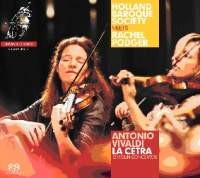
Vivaldi: La Cetra, op.9
Rachel Podger; Holland Baroque Society
Channel

"La cetra ('The Lyre') was published in Amsterdam in 1727, dedicated to the Austrian emperor, Charles VI... the set as a whole demonstrates Vivaldi's remarkable ability to find continually renewed inspiration in writing for solo violin with string orchestra... Podger plays with her customary beauty of tone, purity of tuning and lively variety of articulation. Her melodic decorations in the slow central movements give a delightfully unforced, spontaneous impression." - Duncan Druce, Gramophone.
"The musicians are truly engaged with the music... They clearly found a great deal of joy in recording thse concertos, and it's easy to hear. The fast passages are crisp and fiery—and really fast!—while slow passages come off with an easy, languid grace. Rachel Podger's playing is so good that it's transparent—you don't even notice it, and then when you do, you think it isn't possible. The music just is, and it's beautiful, and there aren't any bad notes to spoil it. Kind of like heaven." - Ardella Crawford, American Record Guide.
   
Runners-up:
Purcell: Twelve Sonatas of Three Parts. Retrospect Trio [Linn]
Milton and Peerson: "Sublime Discourses". Fretwork [Regent]
Vivaldi: Bassoon concertos, volume 2. Sergio Azzolini; L’Aura Soave Cremona/Diego Cantalupi [Naive]
Bach: Solo violin music. Amandine Beyer [Zig Zag Territoires]

More first appearances by labels: Regent and Zig Zag. The winners of this category over the years have—with the exception of last year's "Venezia" disc from the Rare Fruits Council—all been recordings of the three Baroque giants, Vivaldi, Handel, and JS Bach.

Awards 2012 - Baroque Vocal

Bach: Motets
Monteverdi Choir; English Baroque Soloists/John Eliot Gardiner
Soli Deo Gloria

"John Eliot Gardiner writes (and he always writes eloquently), “Bach’s motets constitute the most perfect, and in some ways the most hypnotic, set amongst his works.” The motets are not, strictly speaking, a set. They are independent pieces, each unique in its own way, grouped by the accident of their survival. But they are also united by their seriousness, and by the accidental fact that the six canonical motets fit on a single CD... As always, the choir sings with remarkable precision. And much is demanded of them. Gardiner, it seems, has molded every phrase to bring out the meaning of the words, much like a Lieder singer shaping a song to enhance its story. He does so without diminishing the coherence of the overall work. This would be a challenge for a soloist. For a chorus it is really quite an astonishing accomplishment." - George Chien, Fanfare.
"Some might find Gardiner's approach theatrical; he could persuasively counter that the motets engage unflinchingly with matters of life and death. And if his Erato recording of this repertoire 30 years ago wears its age well at a purely musical level, it's clear that his understanding of their multi-faceted richness has deepened immeasurably." - Paul Riley, BBC Music Magazine.

Runners-up:
Vivaldi: Farnace. Max Emanuel Cencic et al; I Baroccchisti/Diego Fasolis [Virgin]
Briceño: "El fenix de Paris". Le Poème Harmonique/Vincent Dumestre [Alpha] 
"Le triomphe de l'amour". Sandrine Piau; Les Paladins/Jérôme Corréas [Naive]
Falvetti: Il diluvio universale. soloists; Cappella Mediterranea; Namur Chamber Choir/Leonardo Garciá Alarcón [Ambronay]

This is John Eliot Gardiner's second Nereffid's Guide Award (the first was for "Pilgrimage to Santiago" in 2007. And we welcome another new label among the runners-up: Alpha's "El fenix de Paris" got here by a slight bending of the rules; only two of my six major sources reviewed it, which ruled it out of contention, but it got so much support from foreign-language reviewers that I felt bound to include it.

Awards 2012 - Solo Instrumental

Beethoven: Diabelli Variations
Andreas Staier
Harmonia Mundi

This album got the highest average score of all and is therefore the Recording of the Year.
"I have several recordings of Beethoven's Diabelli Variations. It is a work that I have long appreciated but this latest disc from Andreas Staier stands out. First, it's the most infectiously joyous recording I have of the Diabellis. At times, Staier's performance makes me almost want to get up and dance... Second, this recording is made on a fortepiano, with delicious, rich sound, which brings back the music as Beethoven heard it - or would have, if his hearing were better. Finally, this disc includes not only Beethoven's variations, but also a selection of variations from other composers." - Kirk McElhearn, MusicWeb International.
"Staier's perfectly judged tempi, angular demeanour, characterful contrasts, biting accents and cumulative sweep add up to a performance that abounds with probing details yet never loses sight of the music's grand design... This is far and away the most stimulating and best-played fortepiano Diabelli Variations on compact disc." - Jed Distler, Gramophone.

Runners-up:
Schubert: Piano sonatas D840, D850, D894, etc. Paul Lewis [Harmonia Mundi]
Liszt: Années de Pèlerinage. Bertrand Chamayou [Naive]
Mozart: Keyboard music, volume 3. Kristian Bezuidenhout [Harmonia Mundi]
"Fantasia". Yuja Wang [DG]

Given the traditional dominance of the piano in the Solo Instrumental category, it's nice to see some little progress, in the shape of two recordings on fortepiano (Bezuidenhout's is the other). Also noteworthy is the fact that Harmonia Mundi has three of the five albums here.

Awards 2012 - Chamber

Beethoven: String trios, op.9
Frank Peter Zimmermann; Antoine Tamestit; Christian Poltéra
BIS

"The five String Trios Beethoven completed in the 1790s were stepping-stones on his path to becoming one of the great composers of string quartets. But they're much more than just apprentice pieces: they are fully accomplished and strikingly beautiful works in their own right... Heard in full surround-sound, this CD gives the impression that the players are actually in the room with you. The playing itself is dazzling, combining expressive warmth and admirable clarity" - Misha Donat, BBC Music Magazine.
Displaying impeccable teamwork the players give these splendid Beethoven scores with a spring in the step and a sparkle in the eye yet they also draw deep to achieve a remarkable gravitas to set alongside an abundance of spirit in these assured and tasteful performances. This marvellous BIS disc was a delight from start to finish and ranks alongside the renowned recording from the Grumiaux Trio." - Michael Cookson, MusicWeb International. 

Runners-up:
Sarasate: Music for violin and piano, volume 3. Tianwa Yang; Markus Hadulla [Naxos]
Bartók: Violin sonatas; Rhapsodies. James Ehnes; Andrew Armstrong [Chandos]
Shostakovich: String quartets nos.5-8; Miaskovsky: String quartet no.13. Pacifica Quartet [Cedille]
Ravel: Music for violin and piano; Lekeu: Violin sonata. Alina Ibragmiova; Cédric Tiberghien [Hyperion]

Awards 2012 - Concerto

Delius: Double concerto; Violin concerto; Cello concerto
Tasmin Little; Paul Watkins; BBC Symphony Orchestra/Andrew Davis
Chandos

"To those Delius skeptics—and I must admit I was one of them—I say this: If any recording of the composer’s music can make you into a believer, this is it. Perhaps it took SACD technology to finally reveal all of the delicate tints, shadings, and exquisite combinations of colors embedded in Delius’s orchestral textures. Tasmin Little and Paul Watkins seem to rise from their immersion in these pellucid waters as holy messengers delivering the good news. This is one fantastic recording, graced by gorgeous playing, and not just by Little and Watkins, but also by the BBC Orchestra under the keen stewardship of Sir Andrew Davis. All, including Chandos’s engineering and production team, are to be congratulated." - Jerry Dubins, Fanfare.
"A most interesting further point is that these three concertos were recorded over just two days: the concentration and application of consistent musicianship towards this composer's major concerted works is surely unique in recording history and has contributed to the realization of the greatness of this music in a way that makes the acquisition of this disc an urgent necessity." - Robert Matthew-Walker, International Record Review. 

Runners-up:
Shostakovich: Piano concertos; Violin sonata. Alexander Melnikov; Isabelle Faust; Mahler Chamber Orchestra/Teodor Currentzis [Harmonia Mundi]
Berg, Beethoven: Violin concertos. Isabelle Faust; Orchestra Mozart/Claudio Abbado [Harmonia Mundi]
Nielsen, Tchaikovsky: Violin concertos. Vilde Frang; Danish Radio Symphony Orchestra/Eivind Gullberg Jensen [EMI] 
Beethoven: Complete works for piano and orchestra. Howard Shelley; Opera North Orchestra [Chandos]

2012 was Delius's 150th birthday, so this winning disc makes a fine celebration. This category proved to be something of a titanic struggle, which I thought Isabelle Faust might win; American Record Guide's review of her Berg concerto will appear in a future installment of "Did you even listen to the same CD?"

Awards 2012 - Symphony

Brian: Symphony no.1, 'Gothic'
soloists; choirs; BBC Concert Orchestra; BBC National Orchestra of Wales/Martyn Brabbins
Hyperion

"Havergal Brian's Gothic is his most "popular" symphony, with a total of six and a half performances... Roger Wright of the BBC and the people assembling the resources for his Leviathan must have felt a bit like Ike getting his D-Day logistics in hand. Following Brian's demands more closely than any other, this performance used more than 750 singers and an orchestra of 210... This performance is one of transcendent skill. From the soloists all the way across to the children's choirs, there's conviction in the work's musical value and confidence in its execution... To snitch HP Lovecraft's favorite adjective, the orchestral playing from beginning to end can only be described as Cyclopean." - Don O'Connor, American Record Guide.
"In a sense, Hyperion's release is a perfect one, of a great event, a magisterial work and an encapsulation of the enormous difficulties of the project as a whole." - Guy Rickards, Gramophone. 

Runners-up:
Bruckner: Symphony no.9 (four-movement version). Berlin Philharmonic/Simon Rattle [EMI]
Pettersson: Symphonies nos.1 and 2. Norrköping Symphony Orchestra/Christian Lindberg [BIS]
Prokofiev: Symphony no.5; The Year 1941. São Paulo Symphony Orchestra/Marin Alsop [Naxos] 
Messiaen: Turangalîla Symphony. Steven Osborne; Cynthia Millar; Bergen Philharmonic Orchestra/Juanjo Mena [Hyperion]

A year for symphonic improbabilities, in some ways: aside from the very fact of this Gothic's existence, we also meet a completion of Bruckner's unfinished 9th symphony, as well as one of Pettersson's incomplete 1st.

Awards 2012 - Orchestral

Debussy: Orchestral works
Royal Scottish National Orchestra/Stéphane Denève
Chandos

"The Royal Scottish Orchestra, recorded in ravishingly subtle surround sound, makes the most beautiful Debussyan noises I have ever heard. No string instrument scrapes too close to the bridge, no trumpet penetrates unpleasantly. Each delicate wind sounds softer and more ravishing than the next. The progress of this orchestra into the front ranks in recent years has been steady, but I never expected anything this good. Denève’s ability to synthesize total clarity, velvet, and the fire of Charles Munch into a dazzlingly live tour of Debussy’s world marks him, for me, as today’s preeminent French conductor. It all sounds disarmingly eager and spontaneous." - Steven Kruger, Fanfare. 
"Denève is a master of the big picture as well as of the detailed components of this music. In fact, the image that kept coming to my mind when listening to these discs was of the conductor as an artist working on a canvas, crafting something organic which is taking shape before the listener rather than setting down something concrete and complete... What fantastic colours Denève has at his disposal! Under his directorship the RSNO have gone from strength to strength and it is no exaggeration to say that they can now hold their own in the company of the great orchestras of Europe." - Simon Thompson, MusicWeb International.

Runners-up:
Falla: Nights in the Gardens of Spain; The Three-Cornered Hat; Homenajes. BBC Philharmonic/Juanjo Mena [Chandos]
Lutosławski: Orchestral works, volume 2. BBC Symphony Orchestra/Edward Gardner [Chandos]
Roussel: Le festin de l'araignée; Padmâvatî. Royal Scottish National Orchestra/Stéphane Denève [Naxos]
Shostakovich: New Babylon. Basel Sinfonietta/Mark Fitz-Gerald [Naxos]

Denève and the RSNO won the first Orchestral award in 2007 for Roussel's Bacchus et Ariane, they were runners-up in 2008 with Roussel's 2nd symphony, and another of their Roussel discs is a runner-up here, which makes them the most acclaimed orchestra/conductor combination over the six years of the Awards' history. Let's also note that Chandos earned the top three places in this category, just as it did last year.

Awards 2012 - Solo Vocal

"Ferne Geliebte" - Beethoven, Berg, Haydn, Schoenberg
Christian Gerhaher; Gerold Huber
Sony

"Each disc by Christian Gerhaher and his accompanist, Gerold Huber, is a keenly awaited event. In this latest recital he spans the history of the German Lied from the earliest song-cycle, Beethoven's An die ferne Geliebte, to what David Murray, in Alan Blyth's Song on Record, describes as 'the last great voice-and-piano cycle in the Lied tradition', Schoenberg's Das Buch der hängenden Gärten. It is a selection of works in which Gerhaher seeks to widen our perception of him, not only as an interpreter but also as a singer technically" - Richard Fairman, Gramophone.
"You can take the beauty of his tone for granted: it’s silky, gentle, warm and very beautiful, a worthy successor to the likes of Fischer-Dieskau. What sets him out as special, however, is the supreme intelligence with which he combines his vocal tone with interpretation of the words. He has the ability to render vivid even a cycle as well known as An die Ferne Geliebte through the way he, for example, holds on to a consonant for just that tiny moment longer, or the way he elides one phrase into another so as to shine a new light on a phrase the listener thinks he knows inside out. He sounds as if he is creating this music not just afresh but almost for the very first time. In fact there is an exploratory, almost tentative nature to his singing that is incredibly compelling, at times nigh heartbreaking." - Simon Thompson, MusicWeb International.

Runners-up:
Lutosławski: Vocal works. Lucy Crowe; Christopher Purves; Toby Spence; BBC Symphony Orchestra/Edward Gardner [Chandos]
Britten: Serenade; Nocturne; Finzi: Dies Natalis. Mark Padmore; Britten Sinfonia/Jacqueline Shave [Harmonia Mundi]
Berlioz: Les nuits d'été; Herminie; Ravel: Shéhérazade. Véronique Gens; Orchestre National des Pays de la Loire/John Axelrod [Ondine]
Liszt: Lieder. Diana Damrau; Helmut Deutsch [Virgin]

Christian Gerhaher and Gerold Huber won this award in 2010 too, for their Mahler recital, and they were key contributors to "Terezin/Theresianstadt", 2007's winner. Edward Gardner's Lutosławski series makes a second appearance this year (see Orchestral).

Awards 2012 - Choral

"A Song of Farewell: Music of Mourning and Consolation"
Gabrieli Consort/Paul McCreesh
Signum

"A daringly slow tempo—far slower than most choirs could manage technically—with no sense of strain whatever in supporting the voices; the little dynamic swell on 'vengeance' in  verse two; a perfectly poised pianissimo to start verse three. Already in Gibbons's Drop, Drop, Slow Tears there are numerous indications of the elevated artistry Paul McCreesh and the 22 singers of his Gabrieli Consort bring to this beautifully planned and executed programme." - Terry Blain, BBC Music Magazine. 
"This is a disc of staggering beauty and effortless sophistication. Every element of it oozes care in conception and execution right down to the austere simplicity of the pure white booklet design and tastefully discreet aquamarine print... Not all the works are specifically settings of the liturgy for the dead but the abiding emotion is one of reflection and ultimate redemption. In the hands of lesser groups this might make for a rather high quality even saccharine background music CD. The Gabrieli’s enormous skill is their super-sensitive response to the texts and an extraordinarily fine control of dynamic, balance and line." - Nick Barnard, MusicWeb International.

Runners-up:
Poulenc: "Half Monk, Half Rascal". Danish National Vocal Ensemble/Stephen Layton [OUR Recordings]
Howells: Requiem, etc. Choir of Trinity College, Cambridge/Stephen Layton [Hyperion]
Berlioz: Requiem. Gabrieli Consort; Wroclaw Philharmonic/Paul McCreesh [Signum]
Brahms: Works for chorus and orchestra. Collegium Vocale Gent; Orchestre des Champs-Elysées/Philippe Herreweghe [Phi]

Two appearances for McCreesh and the Gabrielis here—and two appearances for Howells' Requiem, which is on "A Song of Farewell" as well as the Trinity disc.