Wednesday, October 17, 2012

Awards 2007: Chamber

Schubert: String quartets nos.13 & 14
Takács Quartet
Hyperion

In Fanfare, James Reel says "This is an exceptional release from an ensemble with no shortage of such things in its catalog". A few issues later, his colleague Bart Verhaeghe also reviews the disc: "Granted, we’re not short of sublime recordings of these two great string quartets, but sometimes one is stunning, and so we reviewers should grant it the attention it deserves (of course, that’s our pleasure)... It is unnecessary to repeat what has been said before, but certainly worth a little recapturing; this recording is quite thrilling". David Hurwitz says on Classics Today, "Hyperion already has cornered the market with its roster of top pianists, and with this release the label looks about ready to do so with string quartets as well". 

Runners-up:
Kalliwoda: String quartets nos.1-3. Talich Quartet [Calliope]
Toch: Tanz-Suite; Cello concerto. Christian Poltéra; Spectrum Concerts Berlin/Thomas Carroll [Naxos]
Bartók: String quartets nos.5 & 6. Arcanto Quartet [Harmonia Mundi]
Viola music by Brahms, Bridge, Enescu, Franck, Glinka, Tabakova. Maxim Rysanov; Evelyn Chang [Avie]

Awards 2007: Concerto

Aho, Nielsen: Clarinet concertos
Martin Fröst (clarinet); Lahti Symphony Orchestra/Osmo Vänskä
BIS

Martin Fröst "seems to have Nielsen's irascible masterpiece in his bloodstream, as surely as he has its technical contortions under his fingers", according to David Fanning in Gramophone. "Few would now question the status of the Nielsen as the finest clarinet concerto of the 20th century. Time will tell with Kalevi Aho's concerto in the 21st. In the short term it will probably daunt as many prospective soloists and orchestras as Nielsen's work did in its time. But there can have been few equally impressive head-on engagements with the concerto medium in recent years". Göran Forsling on MusicWeb has no doubts: "A clear winner on all accounts and Aho’s concerto is pre-destined to be a standard work".

Runners-up:
Tchaikovsky: Violin concerto, etc. Julia Fischer; Russian National Orchestra/Yakov Kreizberg [Pentatone]
Honegger: Cello concerto, etc. Christian Poltéra; Malmö Symphony Orchestra/Tuomas Ollila-Hannikainen [BIS]
Szymanowski: Violin concertos nos.1 & 2. Ilya Kaler; Warsaw Philharmonic Orchestra/Antoni Wit [Naxos]
Sibelius, M Lindberg: Violin concertos. Lisa Batiashvili; Finnish Radio Symphony Orchestra/Sakari Oramo [Sony] 

Awards 2007: Symphony

Beethoven: Symphonies nos.1-9
Scottish Chamber Orchestra; Philharmonia Orchestra/Charles Mackerras
Hyperion

Owen E Walton is forthright on MusicWeb: "I will say immediately that this latest cycle is perhaps the finest that I have heard, if such a statement does not appear absurd. For here we have all the gains of historically informed performance and up to date research without the studied caution that so many conductors have brought to the period performance movement in recent years... To have the greatest works of one of our finest composers conducted with such understanding by one of the late-twentieth century’s finest and most enquiring conductors would be a privilege even at full price. At Hyperion’s modest price tag this is certainly the Beethoven set to have". This category represents the first time I've had to invoke a particular eligibility criterion: only one entry from a recording series is allowed among the finalists. In this case, two of Paavo Järvi's Beethoven symphony recordings made it to the shortlist, but I dropped the lower-ranked one (of the 4th and 7th symphonies).

Runners-up:
Beethoven: Symphonies nos.3 & 8. Deutsche Kammerphilharmonie Bremen/Paavo Järvi [RCA]
Ives: Symphonies nos.1 & 4. Dallas Symphony Orchestra/Andrew Litton [Hyperion]
Schumann: Symphonies nos.2 & 4 (Mahler versions). Leipzig Gewandhaus Orchestra/Riccardo Chailly [Decca]
Villa-Lobos: Symphony no.2; New York Skyline Melody. Radio-Sinfonieorchester Stuttgart des SWR/Carl St.Clair [CPO]

Awards 2007: Orchestral

Roussel: Bacchus et Ariane; Symphony no.3
Royal Scottish National Orchestra/Stéphane Denève
Naxos

"One is drawn in, beguiled, and perpetually surprised. For sheer vivacious cogency, this Bacchus goes to the top of the heap", says Adrian Corleonis in Fanfare. David Hurwitz on Classics Today: "What makes the performance so special is that all of this excitement never compromises precision of execution, or that special sparkle and lightness of touch that we have come to regard as quintessentially French. This team looks set to become a major musical force, and a genuine star of the Naxos catalog. Keep it coming, please!"

Runners-up:
Nielsen: Orchestral works. Danish National Symphony Orchestra/Thomas Dausgaard [Dacapo]
Ginastera: Estancia; Panambi. London Symphony Orchestra/Gisèle Ben-Dor [Naxos]
Schmitt: Psaume XLVII; La tragédie de Salomé; Suite sans esprit de suite. BBC National Orchestra of Wales/Thierry Fischer [Hyperion]
Alwyn: Elizabethan Dances; Oboe concerto; etc. Royal Liverpool Philharmonic Orchestra/David Lloyd-Jones [Naxos] 

Awards 2007: Solo Vocal

"Terezín/Theresienstadt"
Anne Sofie von Otter; Christian Gerhaher; Bengt Forsberg; Gerold Huber; et al
DG

Anne Sofie von Otter explains that this album "reflects my sincere wish to commemorate those who created music under conditions of unthinkable misery and who so tragically lost their lives". On MusicWeb, Steve Arloff says "This disc is an absolute must for anyone interested in sampling music by those whose lives were cruelly cut short by a monstrous ideology, and who would have made further hugely important contributions to the music of the 20th century... This is my nomination for Disc of the Year without reservation". As Robert A Moore puts it in American Record Guide: "Sometimes one is privileged to discover a recording that has as much merit for its humanitarianism as for its musical significance".

Runners-up:
FG Scott: "Moonstruck". Lisa Milne; Roderick Williams; Iain Burnside [Signum]
Grieg: Olav Trygvason; orchestral songs. Marita Solberg et al; Bergen Philharmonic Orchestra/Ole Kristian Ruud [BIS]
Kate Royal. Kate Royal; Academy of St. Martin in the Fields/Edward Gardner [EMI]
"Helsinki Recital". Karita Mattila; Martin Katz [Ondine]

Awards 2007: Choral

Berlioz: L'enfance du Christ
Yann Beuron et al; Tenebrae Choir; London Symphony Orchestra/Colin Davis
LSO Live

This is "gentle, lyrical Berlioz", says Philip Greenfield in American Record Guide. "From any angle - choir, soloists, orchestra, conducting - this new offering looms large in the Berlioz discography and in the choral canon". But hasn't Colin Davis already recorded this work before? Yes, and, says Robert Levine on Classics Today, this one "strikes me as the finest... Davis' understanding of Berlioz’s layering of sounds remains unsurpassed."

Runners-up:
Stockhausen: Stimmung. Theatre of Voices/Paul Hillier [Harmonia Mundi]
Brahms: German Requiem. Dorothea Röschmann; Thomas Quasthoff; Rundfunkchor Berlin; Berliner Philharmoniker/Simon Rattle [EMI]
Bantock: Omar Khayyám. Catherine Wyn-Rogers et al; BBC Symphony Chorus and Orchestra/Vernon Handley [Chandos]
Martin: Le vin herbé. Sandrine Piau et al; RIAS Chamber Choir; Scharoun Ensemble/Daniel Reuss [Harmonia Mundi]

Awards 2007: Opera

Mozart: Don Giovanni
Johannes Weisser et al; Freiburger Barockorchester/René Jacobs
Harmonia Mundi

"For a wholly engrossing performance of this eternal masterpiece with swathes of cobweb blown away, this is a set that should be in every collection irrespective of how many other versions one already has" - Göran Forsling on MusicWeb. Richard Wigmore in Gramophone states that this is "among the liveliest and most enjoyable on offer. It is certainly one of the most brilliantly played." True, he warns that "Jacobs being Jacobs, there are controversial things here". But this is an awards celebration so let's not get bogged down in controversies. Robert Levine on Classics Today says "At this point, my recommendation for a complete recording favors this new Jacobs". This category, incidentally, was the worst for the major labels, something surely unthinkable a couple of decades ago: of the 37 recordings that made the final long list, just two were released by major labels (Donald Runnicles' Tristan on Warner, and an Andrea Bocelli-led Pagliacci on Decca). Another fun fact: Opera Rara recordings came 4th, 6th, 7th, 8th, and 9th on the long list.

Runners-up:
Humperdinck: Hansel and Gretel. Jennifer Larmore et al; Philharmonia Orchestra/Charles Mackerras [Chandos]
Nono: Prometeo, Tragedia dell’ascolto. Various artists [Col Legno]
Mercadante: Maria Stuarda. Judith Howarth et al; Philharmonia Orchestra/Antonello Allemandi [Opera Rara]
Dukas: Ariane et Barbe-Bleue. Lori Phillips et al; BBC Symphony Orchestra/Leon Botstein [Telarc]

Monday, October 15, 2012

Awards 2007: Opera Recital

"Russian album"
Anna Netrebko; Orchestra of the Mariinsky Theatre/Valery Gergiev
DG

Anna Netrebko also appears as a runner-up in this category, duetting with Rolando Villazón, who further appears as a runner-up on his own. Opera Recital is traditionally the least-populated of all the categories, and this year was no exception. But there are no doubts about the quality. "This is the best disc Netrebko has made so far and should make many new friends for Russian opera", according to Patrick O'Connor in Gramophone. Meanwhile on MusicWeb, Göran Forsling says "Anna Netrebko is blessed with one of the most beautiful voices in the operatic world today and she has polished her technique to such an extent that she can carry through anything she wants to do. But this is only one prerequisite of becoming a good opera singer, albeit an important one. What makes her stand out is her ability to catch the various moods of her arias and create a believable character... there are musical riches aplenty and once heard these arias will be friends for life".

Runners-up:
"Arias for Rubini". Juan Diego Flórez; Accademia Nazionale di Santa Cecilia/Roberto Abbado [Decca]
"Gitano". Rolando Villazón; Orquesta de la Comunidad de Madrid/Plácido Domingo [Virgin]
"Duets". Anna Netrebko; Rolando Villazón; Staatskapelle Dresden/Nicola Luisotti [DG]
"Great Operatic Arias". Jennifer Larmore; Philharmonia Orchestra/David Parry [Chandos]

Awards 2007: Living composer - Instrumental

Tüür: Symphony no.4, 'Magma'; etc.
Evelyn Glennie; Estonian National Symphony Orchestra/Paavo Järvi; Estonian Philharmonic Chamber Choir
Virgin


Maybe it's not wise to begin by offering a warning, but here's one from Jerry Dubins in Fanfare: "Like the wrinkled face of a Shar-Pei that only a mother could love, Tüür’s external features are likely to be embraced only by those who do not put much stock in surface beauty." Clearly, Hubert Culot of MusicWeb is one of those, as he says: "These impeccable performances are a pure joy from first to last. Needless to say, too, that Evelyn Glennie almost effortlessly navigates through the often demanding and physically taxing percussion part... I warmly recommend this magnificent disc not only to lovers of Tüür’s music but also to all those who enjoy vital, all-embracing music of great communicative strength."

Runners-up:
Rorem: Piano concerto no.2; Cello concerto. Simon Mulligan; Wen-Sinn Yang; Royal Scottish National Orchestra/José Serebrier [Naxos]
Corigliano: Violin concerto, 'The Red Violin'; Violin sonata. Joshua Bell; Jeremy Denk; Baltimore Symphony Orchestra/Marin Alsop [Sony]
Cerha: Cello concerto; Schreker: Chamber Symphony in A. Heinrich Schiff; Netherlands Radio Chamber Orchestra/Peter Eötvös [ECM New Series]
Corigliano & Friedman: Works for string quartet. Corigliano Quartet [Naxos]

Awards 2007: Living composer - Vocal

Lieberson: Neruda Songs
Lorraine Hunt Lieberson; Boston Symphony Orchestra/James Levine
Nonesuch

Reviewers were deeply touched by the love story behind this recording of music composed by Peter Lieberson for his wife, and her death from cancer just six months after this recording was made. So there was no doubt some sentimentality in the warmth with which the album was received - but the quality of the music wasn't in doubt either. James H North in Fanfare: "It is hard to say which is more beautiful, the music or the singing, because they are inseparable. His compositions have never been so simple, so pure, cleansed of all excess, all adornment. Her singing has never seemed so true, so removed from the necessary artifices of vocal production. He subtly captures the Spanish aura of the songs, which she recreates indelibly."

Runners-up:
Rautavaara: "Song of my heart". Gabriel Suovanen; Helsinki Philharmonic Orchestra/Leif Segerstam [Ondine]
Lauridsen: "Nocturnes". Polyphony; Britten Sinfonia/Stephen Layton [Hyperion]
Bingham: The Secret Garden; Salt in the Blood; etc. BBC Symphony Chorus/Stephen Jackson; Fine Arts Brass Ensemble [Naxos]
Vasks: Pater Noster; Dona nobis pacem; Missa. Latvian Radio Choir; Sinfonietta Riga/Sigvards Klava [Ondine]

Sunday, October 7, 2012

I am so sick of these people

Efforts to find a cheaply downloadable (ie, available on eMusic) recording of Rachmaninov's Symphony no.1 brought me to a 1979 performance by Gennadi Rozhdestvensky with the BBC SO, released on BBC Legends.

Bob Briggs on MusicWeb:
...at the time, this performance was a revelation. It’s high powered, passionate and forthright... this is an interpretation of great stature and one of the best performances of the work currently available.
Barry Brenesal in Fanfare:
...an impressive affair, buoyed along by the conductor’s attention to detail and the grandly theatrical gesture. ... This recording has quickly moved to the front rank of my favorites, alongside Svetlanov
Andrew Achenbach in Gramophone:
...a perplexing letdown. Rozhdestvensky presides over a fitfully involving but at times uncomfortably rowdy display that does his reputation no favours at all... the performance as a whole pales next to the towering splendour of Svetlanov's volcanic 1966 recording


(And now it's time for my semi-regular apology for not blogging. Many many circumstances have been intervening. But in a couple of weeks I hope to have a spectacular retrospective Nereffid's Guide Awards thing. Stay tuned.)
 

Friday, August 3, 2012

Samplers, and starting out

For some reason, I hadn't noticed that Hyperion has been giving away monthly samplers for download on its web site for the last several months. So now I'm enjoying several months' worth of samples - because Hyperion seems quite unhorrified at the idea that it could be losing millions, if not billions, of pounds' worth of revenue from people downloading 5-month-old free tracks.
Ah, samplers. They were what helped me discover a lot of music in my early classical years (I posted about that ages ago), and the Hyperion ones are fine examples. But does anyone discover music (in the broad sense) in that way anymore? Back in 1992 - my early classical days and also, I'm reminded, the year that saw the launch of both BBC Music Magazine and Classic FM - there weren't many options. But these days you have Amazon selling the complete Mahler symphonies for download for under a dollar, not to mention various other huge collections of varying quality for relatively small change, and much of the difficulty of building up a decent-sized (and, for that matter, decent) classical collection has been eliminated. But maybe so has some of the fun, too.
A couple of weeks ago I bought, second-hand, David Hurwitz's Beethoven or Bust, a guide for the absolute beginner that was published in - hey! - 1992. His basic idea is that you don't need any significant understanding of music theory or history before you start listening and enjoying, which was certainly true in my case, but at the same time he spends much of the book pointing the reader in certain directions and warns against "the temptation to progress too quickly". Perhaps there's something to be said for simply getting 10 hours of Chopin for a tenner and seeing what works for you. But I like Hurwitz's idea better: listen to Chopin's Études along with those by Schumann and Debussy, and Bach's Inventions; listen to Chopin's Piano sonata no.2 along with Alkan's Grande Sonate, Ravel's Gaspard de la nuit, and Rachmaninov's Sonata no.1; and listen to Chopin's Preludes and Waltzes in the company of Debussy's Preludes and, most intriguingly, Alwyn's Fantasy Waltzes. I'd never even heard of those - words that in my mind always accompany the humble sampler.

Monday, July 16, 2012

Napoleon and music

Here's some bits from Vincent Cronin's superb biography of Napoleon:
French music, he once complained to Etienne Méhul, had no grace, no melody. Méhul, piqued, shut himself up in his room, composed an Italian-style opera, entitled it L'Irato and, passing it off as a work by an unknown Italian, had it performed. Napoleon went to the first night, liked the melodies, clapped and kept remarking to Méhul, who sat beside him, 'Nothing can touch Italian music.' The last notes died, the singers made their customary three bows, and the name of the composer was announced: Etienne Méhul. Napoleon was taken completely by surprise, but later he said to Méhul, 'By all means trick me again.'
To his favourite singer, Girolamo Crescenti, Napoleon gave the Iron Crown. As the Crown was usually reserved for bravery on the battlefield, critics began to murmur, until silenced by Giuseppina Grassini's quip: 'Crescenti's been wonded' - he was a castrato.
We're told that Napoleon went to about 10 performances of Italian opera in a year, 8 of comic opera, and 2 or 3 of French opera. "His favourite instrument was the human voice and his favourite music that of Giovanni Paisiello, who has been called the Correggio of music. Of the aria 'Già il sol' in Paisiello's pastoral, Nina, he said that he could listen to it every evening of his life".
Hmm. If you want to live vicariously as Emperor of France by listening to that aria, you'll have a little trouble finding it - according to ArkivMusic there's just a couple of CD recordings of the complete opera and one DVD, and not a single stand-alone recording of 'Già il sol'. This despite not just Napoleon's opinion but what the 1980 Grove says of the opera: "a work important because of the exceptional acclaim it received during its composer's lifetime and because it is a locus classicus of 18th-century sentimental comedy in music". As for the aria in question, it appears to be one of the "tunes of almost naive simplicity" that crop up in Nina.
The Empire was a great period for opera. Lesueur, the son of a Norman peasant, gave his Ossian ou les Bardes in 1804, and three years later Le Truimphe de Trajan... Another important opera was Spontini's La Vestale... The Academy of Music disapproved of the opera and it was only because Josephine liked it so much that Napoleon had it performed. It proved a big success and in the next few years had 200 performances. The subject of yet another opera, Spontini's Fernand Cortez, was suggested by Napoleon. it brought on stage, for the first time, fourteen horsemen; a journalist suggested that a sign be affixed to the theatre door: 'Opera performed here on foot and on horseback.'
Well, La Vestale lives on, not least because of a Maria Callas recording. You can also hear Renata Tebaldi in (if not as) Fernand Cortez. But Jean-François Le Sueur seems to have gone the way of most sons of Norman peasants, though you can hear what Arkivmusic lists as his "Marche du Sacre de Napoléon ler" on a couple of recordings.
Roman generals, conquistadores, Celtic chiefs - armed to the teeth, they trooped on to the Empire stage. But if opera came to resemble battle, battle owed more than a little to opera. It is a remarkable fact that when French troops marched against the enemy they did so to the sound of operatic music. 'Veillons au salut de l'Empire', which under the Empire replaced 'La Marseillaise', came from an opera by Dalayrac. Another favourite with the troops, 'Où peut on être mieux qu'au sein de sa famille?' came from the famous duo in Grétry's Lucile, while 'La victoire est à nous' came from the same composer's La Caravane du Caire.
How famous is that famous duo? Well, good luck finding a recording of it. But Vieuxtemps used it in his Violin concerto no.5, which has the nickname "Grétry" as a result.
Oh well, at least the Rights of Man have lasted longer than early 19th-century French music...

Saturday, June 23, 2012

Ho hum, an absolute gem

Here's the latest album from "the great and mysterious Russian pianist Daria Gloukhova", as Lynn René Bayley calls her in Fanfare; "she is so good, that for me at least each release is like a gift from above". Or, as Brent Auerbach said in American Record Guide last year, "Some promise can be seen in the playing of this young Russian pianist, but not enough for me to recommend that you seek her out". This year, Auerbach says "I criticized her for "scrabbly" playing and immature pacing. Although these elements are not yet fully expunged, here they plague only the first work on the program, the Grieg sonata".
Oh dear, Lynn, is the Grieg bad? "one is sucked into Gloukhova's very personal sound world from the very first notes". Well, that doesn't quite answer the question. "This is great piano playing". Ah. Brent? "it quickly becomes clear that even this modest work is too big for her... There is not enough excitement in this performance to even fill a salon, let alone a concert hall". Oh.
What about her John Field? "Even if they were executed perfectly", Auerbach tells us, the nocturnes "might not strike us as much more than quaint". Or, to put it another way, as Bayley does: "That she can be consistently lyrical, yet lack any preciousness or bathos, shines through gloriously in her equally unique readings of John Field's nocturnes".
And the Mendelssohn Fantasy? "a work that she invests with every ounce of her heart and soul", says Bayley. "padding", says Auerbach. Tell us about the first movement! "In the opening Con moto agitato", Bayley says, "one almost feels she is baring her own emotions through the music, so potent is the headlong rush of the agitato passages. The music cascades down the descending 16ths toward a pit of emotional blackness". I'm sorry, I'll read that again, this time using Auerbach's voice: "more dreamy than it is agitated, sounding lost sometimes".
What's the poor consumer to do?-

Sunday, June 17, 2012

An Ars nova mix


Again I'm going to use A History of Classical Music through Recordings as my excuse for not blogging. This latest one took about a month - three days of good ideas, followed by two weeks of absolutely nothing, followed by a week of hard work. The post isn't up on musicisgood.org yet.

Saturday, May 19, 2012

F-D RIP


My first introduction to lieder was Fischer-Dieskau singing Winterreise, but this Mahler is what I want to remember him for. The way he sighs that last word, "Traum"...

Monday, May 7, 2012

Ebsco Publishing ignores Irish Labour Court

No music in this one. Just a campaign for a fair payment. Ebsco Publishing took over The H. W. Wilson Company last year and made all staff redundant. It still won't follow the recommendation of the Irish Labour Court to make redundancy payments more in line with industry norms.
I wrote the following for our campaign blog, Wilson Pickets.

Why We Fight
If you’ve visited our Facebook page or signed our petition, or read the previous post on this blog, you’ll have noticed the imagery of David versus Goliath: we are 19 people taking on a multinational company. However, you might not have grasped the full meaning of this analogy. These days, when people think of a David-and-Goliath scenario, it’s in the context of a plucky underdog taking on a more powerful opponent and winning against the odds. But the story of David and Goliath is much more than that.
David didn’t win because he was especially brave, or because sometimes in true Hollywood fashion the little guy can beat the big guy, or because he got lucky, or even because a big sword is no match for a short-range ballistic weapon. He won because in the Biblical story there was a right side and a wrong side, and David was on the right side. All of Goliath’s size and strength were in fact irrelevant to the outcome of the fight, because Goliath was on the wrong side. And in real life, Ebsco’s market position and its profits and its assets ultimately have no bearing on this fight, because Ebsco too is on the wrong side.
Now, I don’t mean by this that Ebsco has done anything wrong. The company has met its legal obligations by providing redundancy payments that match the statutory minimum. You know when you help someone out and they thank you, and you modestly reply “It’s the least I could do” – well, that’s Ebsco. The company has, literally, done the least it could do.
Why is this not enough? Let’s take another look at the David and Goliath story. The reason David was on the right side was that God had already chosen him to be a future king. Our goals aren’t so exalted: all we want is for Ebsco to follow the recommendation of the Labour Court and offer a redundancy payment more in line with industry norms. We can’t claim divine right, but we do claim workers’ rights. We know that such rights come under threat every time a company chooses to ignore a vital mechanism for promoting good industrial relations. We know that every time a company decides not to play fair and gets away with it, it encourages other companies to do likewise and make a mockery of the system.
Although Ebsco seemed to demonstrate good faith by appearing before the Labour Court to defend its position, the company has so far ignored the court’s recommendation. And if you read the Bible you’ll see that Goliath and the Philistines also initially appeared to be interested in some form of arbitration. Instead of fighting an all-out battle, they proposed single combat to settle the issue – but when the result didn’t go the way they hoped, they turned and ran.
And so we’re now in pursuit of Ebsco, although we have no desire for conquest. We don’t want their heads. We just want a fair acknowledgement of the value of our years of work at H. W. Wilson, the fruits of which will continue to benefit Ebsco for many years to come.
We are not plucky underdogs.
We are on the right side.
And we will keep fighting until justice is done.

Monday, April 30, 2012

Classical Highlights

This is an experimental post! I've done a few "Classical Highlights" posts for Music is Good but I don't think they fit well with the overall blog content in terms of their style. So I figured I'd try to write them as proper overviews rather than just lists of albums accompanied by quotes. This of course would make for a lot of work and produce rather lengthy posts so a better approach might be for me to be selective. The latest issues of the three UK magazines give accolades to 24 discs, so I've halved that number to make my choice. Totally subjective, of course, but as Arthur O'Shaughnessy said, "We are the taste makers / And we are the choosers of stuff". These magazines have been out for a few weeks so it's a bit late to be putting this post up on Music is Good; instead I want to stick it here and "live with it" for a while to decide that it's an okay approach.

A selective overview of some of the top-rated albums in the latest issues of Gramophone (May), BBC Music Magazine (May), and International Record Review (April).
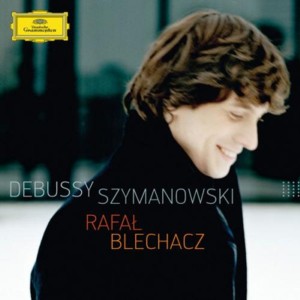
The main focus here must be the latest disc from Rafał Blechacz, a recital of Debussy and Szymanowski (DG 477 9548); it's Gramophone's Recording of the Month and a recipient of an Outstanding from International Record Review. In the latter, Nicholas Salwey says that "Blechacz is most certainly the genuine article, possessed of an immaculate technique married with musicianship of maturity and unassuming modesty". There's more piano music from Hamish Milne (Hyperion CDA67851/2), who's long been a champion of Nikolai Medtner; here he provides a two-disc selection of shorter pieces that Gramophone's Bryce Morrison says "is surely in the running for instrumental issue of the year". And we also have a couple of piano concerto discs: David Fanning in Gramophone describes as "something truly extraordinary" a recording of Shostakovich's two concertos by Alexander Melnikov (Harmonia Mundi HMC 902104), who's also joined by Isabelle Faust in the same composer's violin sonata, and in IRR Robert Matthew-Walker praises Danny Driver's performances of a pair of concertos by the rather less well-known Erik Chisholm (Hyperion CDA67880) - "one of the most important contributions to British recorded music for some considerable time".
Three Brahms discs appear this month, two of them choral. John Eliot Gardiner's recording of the German Requiem (Soli Deo Gloria SDG706) is "a minutely considered, dramatic and, in places, aptly disturbing performance", according to David Threasher in Gramophone, while the same magazine's Marc Rochester describes Philippe Herreweghe's selection of works for choir (PHI LPH003) as "a mouth-wateringly sumptuous cake of a disc". In IRR, Nigel Simeone is impressed by Andrew Manze's new set of the four Brahms symphonies (CPO 777 720-2): "one of the most fiery, original and thought-provoking sets of the symphonies to have appeared in the digital era". Another choral selection is Disc of the Month in BBC Music Magazine: Paul McCreesh's "A Song of Farewell" (Winged Lion/Signum SIGCD281) features "music of mourning and consolation" from a variety of British composers and is, Terry Blain tells us, a "beautifully planned and executed programme". In the same magazine, a recital by soprano Marlis Petersen of Goethe settings spanning two centuries (Harmonia Mundi HMC 902094) provides "revelatory musical incarnations", according to Hilary Finch, while Jonathan Harvey's opera Wagner Dream conducted by Martyn Brabbins (Cypres CYP 5624) is, Christopher Dingle says, a "compelling triumph... Harvey's sublime music does not shy away from the disturbing when necessary, yet the overwhelming impression is of beauty and integrity".
Another release of contemporary music features all four string quartets of Sofia Gubaidulina, performed by the Stamic Quartet (Supraphon SU4078-2), which Ivan Moody in IRR says is "an essential investment for any admirer" of the composer. And finally, two releases of older music. The voices of Stile Antico have combined with the viols of Fretwork to bring us "Tune thy Musicke to thy Hart" (Harmonia Mundi HMU 807554), which according to Peter Quantrill in Gramophone brings "a carefully plotted span (over 120 years) of sacred styles into our listening rooms with rare success". A somewhat obscure fretted instrument, the lirone, features on a selection of 17th-century Italian laments from the ensemble Atalante, headed by Erin Headley (Destino Classics NI6152); IRR's Andrew O'Connor notes "Without wishing to sound snobbish, this is not a programme for the casual listener. It features music written for connoisseurs. Their successors today will find this in every way an outstanding recording".

Sunday, April 29, 2012

"A History of Classical Music...": progress report

The main reason I don't post much here anymore is that I'm spending my writing-about-classical-music time on A History of Classical Music through Recordings, part 5 of which should be up soon. So I'm not even going to promise a series of witty and insightful posts about the upcoming "Maestro at the Opera" or whatever it's called. However, let me interject at this point that the 4 minutes of Young Musician of the Year that I've seen so far made me want to set fire to someone at the BBC. Not everything has to be done like X Factor, for crying out loud. You don't need dramatic underscoring and dramatic editing of the judges' deliberations, in fact you don't need to turn it into a drama at all because this is a showcase for bright and enthusiastic young people with musical talent, not the fucking Hunger Games. In a word: Gaahh!
Where was I? Oh yes. It turns out people have been composing music for literally hundreds of years and apparently it's now possible to examine individual aspects of this activity and discuss them in an average of 1,200 words so that other people can read about them. And you can also create 8tracks mixes for each one, which gives me an excuse for a blog post:


Unsurprisingly, the Gregorian Chant one has had the most listens. How will the Ars Nova fare, I wonder? That'll be Part 6, before we move on to trecento Italy, then England, then back to Burgundy... According to the current plan, Part 22 will see the beginning of the Baroque period. After that - well, I won't get to that point for another year or so. Plenty of time to struggle with how much Bach to include. In the introduction to my history I noted that chronologically based beginner's guides tend to rush through medieval and Renaissance music, one example being 1001 Classical Recordings You Must Hear Before You Die, which devoted just 26 recordings to pre-17th-century music. I'm hoping to have 110 or thereabouts. I won't stretch to 1,000 by the end - in fact I don't know how many I'll have. Maybe 300, maybe 500. In terms of number of chapters the structure I've devised so far keeps approximate pace with one of my models, the Canadian radio series Music and Western Man, which would mean that the year 1600 isn't far from the halfway mark; the Norton A History of Western Music would put it about one-third of the way along, whereas for Richard Taruskin's Oxford History of Western Music it represents only about one-fifth of the journey. Either way, by trying to offer some sort of equal-time approach across all of musical history I'll have some interesting challenges ahead as I move from a situation where I'm focusing on finding important but little-known music to include, to one where I have to decide what well-known music to ignore. Or, to put it another way, the 13th-century Carmina Burana has been included, but should I bother with Carl Orff's much more famous version?

Tuesday, April 10, 2012

Halls of Fame

Oh Christ, that time of year again. But first let's check in at Gramophone, whose new Hall of Fame is much more classy than anything Classic FM can produce. Although personally I think if you're going to have a Hall of Fame, it has to be an actual hall, somewhere my in-laws can visit and send us a postcard from. Anyway, nothing too dramatic has happened in the initial phase of Gramophone's Hall, unless you feel the need to get worked up over the fact that the 50 names include Lang Lang.
You'll be glad to know, however, that teh Internets has been far more successful at ruining the latest Classic FM poll. Apparently the twenty most popular pieces of classical music among listeners of Classic FM include "Aerith's Theme" from Final Fantasy VII; Nobuo Uematsu's tinkly little weepie fits in reasonably well with the station's taste for crossover though I'm not sure what the Classic FM/Final Fantasy Venn diagram looks like. The theme from Skyrim got in as well, though only at no.238. That one's for people who think the Pirates of the Caribbean theme doesn't sound enough like Lord of the Rings, or vice versa.
So, well done nerds on your chart-spiking success, but people who like lovely choral music have beaten you in terms of number of entries, because Jaime Lannister Eric Whitacre has finally made it into the charts with three pieces, while Paul Mealor manages four, one of which, the horribly horribly mawkish "Wherever You Are" as performed by the Military Wives, is straight in at number 5. But it's a pop song, surely?
Hurrah! Western civilisation is over!