Thursday, April 21, 2011

Selling monody

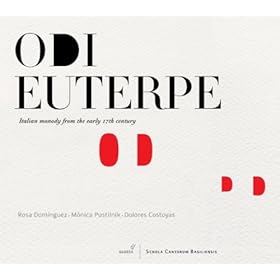
I really like this recent release on the Glossa label, performed by Rosa Domínguez, Mónica Pustilnik, and Dolores Costoyas. And you might like it, too. In fact a lot of people might like it, but what are the chances they'll hear it, or even that they'll want to hear it? "Odi Euterpe: Italian monody from the early 17th century" is the sort of title only a specialist could love. The specialist can look at it and say "ah, so it's got at least one selection from Caccini's Le nuove musiche on it" (though then again you could probably say the same about any album of Italian monody from the early 17th century). But for everyone else, well, it sounds forbiddingly academic, doesn't it? You have to know who or what Euterpe is, and as for "Odi", Babelfish unhelpfully translates it as "hatred". And you have to know what monody is. I am deliberately not going to explain any of it to you, because that's the point I'm making.
So in the unlikely event that you are an inexperienced but curious listener of classical music and you've wandered into the classical section of your local record shop and come across this CD, you're probably going to pick it up, look puzzled, and put it down again. But there are so many unlikely events in there that you can't blame Glossa for not making an attempt to appeal to a market that hardly exists. Are there any feasible ways of promoting this kind of music outside its niche? ECM New Series and Alia Vox do seem to be able to attract a certain type of audience that otherwise doesn't go much for classical. But really what you need is someone to draw attention to this particular album, on a blog for example, and say, "hey, I know you don't listen to this sort of thing usually, and the title might be a bit off-putting, but actually really what this boils down to is a woman singing with a guitar-y sort of backing. It's not exactly singer-songwriter or folk music, but... Here, try a couple of samples", and then they listen to it and it turns out they do like it. Or maybe it doesn't sound enough like KT Tunstall for them and they never listen to your advice again.
Maybe the album could have been called "These Are Some Songs".

Tuesday, April 19, 2011

Whitesnake wins Pullitzer Prize for Music

It has been a long time coming, but David Coverdale and the guys have finally received the recognition they deserve, having won the Pullitzer Prize for Music. The band received the award for... oh. wait. Start again.

Chinese-born composer Zhou Long has won the 2011 Pullitzer Prize for Music for his opera Madame White Snake, "a deeply expressive opera that draws on a Chinese folk tale to blend the musical traditions of the East and the West."
I confess my ignorance of Zhou Long's music, which I shall attempt to rectify. Here I go again...

Monday, April 18, 2011

My father knew Charles Ives, for all the good it did me

Over at On An Overgrown Path, an intruiging proposal:
The new sciece of epigenetics has identified that the cells that make up our body and determine our wellbeing are not controlled primarily by our genes, but rather by the physical and energetic environment in which we live. It is early days and some of the advocates of epigenetics hover uncomfortably between science and shamanism, while similar approaches such as Alfred Tomatis' Mozart Effect continue to be treated with scepticism. But epigenetics is science rather than quackery, and if a medically proven causal relationship could be established between classical music and wellbeing, the case for live music, music education, music therapy and many other threatened activities would become much stronger. To date there has been little attempt to connect epigenetics and classical music. Surely it is it time to explore new ways of arguing the case for classical music?
I left a comment over there, but it's worth expanding a bit. Well, first of all it's worth addressing Pliable's first sentence, which makes a strong but not accurate case for epigenetics. In essence, epigenetics refers to, as Jerry Coyne puts it in a put-down of the hype surrounding the field, "inheritance not based on coding changes in the DNA". Which is to say that the environment (such as a stressful event like a famine) can affect genetics, causing changes not in the structure of DNA but in gene expression, changes that can be inherited (though only for 1 or 2 generations, it seems). Saying that our cells are "controlled primarily" by the environment is an exaggeration. Some specific epigenetics examples are known, but this doesn't of course mean that every single bloody thing that ever happens will cause a heritable change in gene expression, which is what that BBC Horizon thing linked above seems to imply:
At the heart of this new field is a simple but contentious idea – that genes have a 'memory'. That the lives of your grandparents – the air they breathed, the food they ate, even the things they saw – can directly affect you, decades later, despite your never experiencing these things yourself. And that what you do in your lifetime could in turn affect your grandchildren.
Reminds me of Alexei Sayle's joke, along the lines of "They say that what you have to worry about isn't what killed your parents but what killed your grandparents. So I should be fine unless I'm attacked by a horde of Cossacks". As for genes having a memory, this is perhaps just a noble attempt to couch something in layman's terms but it invests a stupid mysticality into the process (the article is titled "The Ghost in Your Genes"). Yes, epigenetics means that a gene has a "memory", in the same way that my downstairs bathroom wall has a "memory" of when my son attacked the wall with a chisel - in this case, the "memory" is also known by the scientific term "holes".
The main point I was making in my comment on OAOP was, if you want to prove that listening to classical music has health benefits, then epigenetics seems an unnecessarily complicated way of going about it. We're talking about transgenerational effects, so unless you don't need results until, say, 2050, you can't study it prospectively. So that means you have to get today's adults and find out how much classical music their parents and grandparents listened to, and come up with an appropriate health benefit to study (stress hormone levels? IQ?). The huge difficulty is eliminating all possible confounders. If you're studying the impact of a famine, that's not so hard - people either went hungry for a period or they didn't - but for classical music you're talking about a lifetime of what you might call low-impact experiences that may often go hand-in-hand with other experiences - reading, for example - as well as accounting for the usual things like educational level and socioeconomic status. And of course these conditions apply not only to the grandparents but the grandchildren too. By deciding on an epigenetics approach you're going for an unnecessarily complicated level of study: why investigate the impact of a lifetime of classical music listening on an individual's children or grandchildren, when we don't even know the impact of same on the individual?
That sort of study would be easier to perform, though maybe not easy to produce a convincing conclusion. The so-called Mozart Effect, on the other hand, is much much easier to study: measure baseline levels of whatever property you're studying (stress hormone levels, IQ); play music for the subjects; measure the new levels; and keep measuring them to see how long the effect lasts. Meta-analyses cast doubt on whether there is an effect, though.
The other thing to remember with all of these approaches to showing societal benefits for classical music is - as commenter mrG alluded to on OAOP - that you must also be prepared for other, competing, studies showing the societal benefits of other forms of entertainment. You think that all Justin Bieber fans do all day is stand around screaming and wetting their pants? Hell no. They're in the labs right now. This is a war, people. We need to be ready.

Friday, April 15, 2011

8tracks mixes: Awards 2010, parts III & IV

At last! Here's the Concerto, Symphony, and Orchestral winners and runners-up, split between two 8-track mixes. As a bonus (well, OK, as a way of making up 16 tracks from 15 albums) there's an extra Gershwin track thrown in.


Thursday, April 14, 2011

Twenty more years?

The record industry's attempt to get EU copyright terms on sound recordings extended from 50 years to 70 has received a big boost with the recent news that Denmark has switched sides. Previously part of a group that was blocking the Parliament-approved proposal at the Council stage, the Danes appear to have received the requisite number of blow-jobs from industry representatives to change their minds. Fortunately the Pirate Party isn't having this, and MEP Christian Engström has found a rule that could send the proposal back to Parliament, if he gets enough support. More details here.
Of course musicians (or, to use the correct term, copyright holders, which isn't necessarily the same thing at all) need a reasonable period in which they have exclusive profit-making rights to their endeavours. But seventy years? Surely fifty is enough. But of course it isn't, because if fifty is enough then in 2014 the first Beatles albums will be out of copyright, and then all those other still-lucrative acts that defined The Sixties will follow. So obviously this would represent a financial threat to the major labels, and apparently that's sufficient to persuade enough European lawmakers to go along with the idea. And in response the anti-extension campaign is highlighting the financial downside to the proposal.
I wonder if part of the problem - I mean the ease with which the 70-year limit is being accepted - is simply a time perception thing. The out-of-copyright Fifties just seem like history, but the still-copyrighted Sixties are still not too far away, musically and socially, and perhaps when a lobbyist says "we must protect this and make sure the artists are supported" it's easier to agree. And it's easier for the lawmaker to look into the future and think "yes, I'm supporting these important artists for another twenty years". But why doesn't the lawmaker look back? If we had a 70-year limit already, then Duke Ellington's "Take the 'A' Train" and Glenn Miller's "Chattanooga Choo-Choo" would still be in copyright. What is the argument to support that?

Wednesday, April 13, 2011

Gold from Westminster

The latest Gramophone has a feature titled "The record covers from hell". Prominent among the 15 "worst record covers of all time" is the seventies label Westminster Gold.

The winner was this:


But I was rather impressed by this one, which is crying out to be Bill Bailey's new look:


All these images are from westminstergold.com. Sometimes they went for an overly literal depiction of the album contents:


This was the era of Benny Hill, remember:


Did they have a "top shelf" in record shops back in those days?


And finally, perhaps the least subtle of all:

BBC Music Magazine Awards

They have just been announced.
Orchestral: Prokofiev - Romeo and Juliet (LSO/Gergiev).
Chamber: Franck, Grieg, Janacek violin sonatas (Repin, Lugansky).
Instrumental: Shostakovich - Preludes and Fugues (Melnikov).
Choral: Bach - Motets (Bach Collegium Japan/Suzuki).
Vocal: Schubert - Winterreise (Güra, Berner).
Opera: Mozart - Die Zauberflöte (Jacobs).
DVD: Purcell - The Fairy Queen (Glyndebourne).
Newcomer: Ivana Gavrič (piano).
Premiere Recording: D Matthews - Symphonies 2 & 6 (BBC NOW/Van Steen).
Technical Excellence: Briggs - Messe pour Notre Dame (Hyperion).

Of course I must compare these results with what other review magazines thought. There's nothing surprising here; the only two that got several not-so-good reviews elsewhere were the two I would expect - the Schubert and Mozart. Winterreise's one of those works that's regarded on just too high a level for any recording to be universally acclaimed as a success, and there are some listeners who just don't like Jacobs's way with the Mozart operas.

Tuesday, April 12, 2011

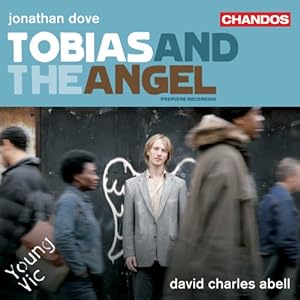
Tobias and the Angel

I hadn't given much thought to what had been my favourite album of 2010, which as it turns out is just as well, because I didn't hear my favourite album of 2010 until about a month ago.
Jonathan Dove's Tobias and the Angel is a "church opera" written in 1999, and Chandos's recording is of a subsequent Young Vic touring production. The story is from the Old Testament (not the Apocrypha. The Council of Trent confirmed it to be canonical. Take that, Protestants!) and is set in Nineveh. Tobit is a man who risks severe punishment by arranging proper burials for Jews killed by the king; for his pains, he's rewarded by being blinded by sparrows shitting in his eyes. Now unable to work, he decides to call in a debt from a relative in Ecbatane. His son Tobias, currently something of a waster, offers to make the journey, on which he is accompanied by a mysterious stranger who (spoiler alert for the very slow) eventually turns out to be the titular angel, Raphael. Having had an odd encounter with a giant fish, they arrive at Ecbatane, where Tobias immediately falls in love with Sara, daughter of the man he's to collect the money from. Unbeknownst to Tobias, Sara's already been married multiple times, with all her husbands dying in their sleep - she's actually possessed by a demon named Ashmodeus. I will leave you to anticipate whether the demon gets exorcised, Tobit gets his sight back, or Raphael reveals his true self to general expressions of awe. And whether the giant fish has anything to do with anything.
Of course, the term "church opera" might suggest Britten to you, and certainly Dove's work does have the sort of music-for-the-people nature of Noye's Fludde and the like. Don't think "staid and holy". If there's a spectrum of staged music stretching from Parsifal to We Will Rock You then perhaps Tobias and the Angel is somewhere in the happy middle ground, along with, say, Stephen Sondheim (follow the undergrown path to yesterday's post). Some of the tunes are highly catchy (Jewish folk music style) and some of the music is inordinately beautiful. There are lots of stand-out moments, such as the cheeky children's chorus of sparrows ("Pee-oo! That was good") or the evocative music accompanying Tobias and Raphael as they set out on their journey. "Popular appeal" is rarely this appealing. Everything flows together wonderfully, and at CD-length it's the perfect size for its story - no padding, and no sense of cramming too much in. And the orchestration is spot-on.

Here's a 2-minute audio clip from the final scene, with Raphael sung by countertenor James Laing:


(Incidentally, I also recommend Chandos's previous Dove opera release, Siren Song, the tale of a sailor in love with a woman he's never met).

Monday, April 11, 2011

Someone in a tree

Yer damn right I bought the new Stephen Sondheim book, Finishing the Hat: Collected Lyrics (1954-1981), with attendant Comments, Principles, Heresies, Grudges, Whines, and Anecdotes. From which we learn, among many other things:
When I'm asked to name my favorite song of those I've written, an understandable but unanswerable request, I often proffer this one. I like the swing and relentlessness of the music and the poetic Orientalism of the lyric, but what I love is its ambition, its attempt to collapse past, present and future into one packaged song form... Suffice it to say that this song comes the closest to the heart of Pacific Overtures: historical narrative as written by a Japanese who's seen a lot of American musicals.


Right hand/Left hand

I'm not sure quite what the relationship between the "Building a Library" feature in BBC Music Magazine and the "Building a Library" segment in BBC Radio 3's CD Review show is. The latter used to inform the former but that doesn't seem to be the case anymore. Anyway, there exist 2 conceptual items from the BBC entitled "Building a Library".
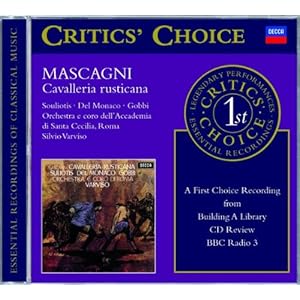
Last month's one in the magazine was Mascagni's Cavalleria Rusticana. The top choice was Karajan/Bergonzi/Cossotto/Guelfi, but what we're interested in here is the one that appears as "One to avoid", about which this month's library-builder Ashutosh Khandekar says
In a field full of great contenders, my caveat goes a set [sic] that has been much praised but has serious flaws. Decca's 1966 version conducted by Silvio Varviso is radiantly recorded and has a great cast, but none of the soloists are caught in their prime. An inexperienced Elena Souliotis makes for a wayward Santuzza. Gobbi has superb dramatic instincts as Alfio, but lacks his finest vocal sheen. And del Monaco has lost the lustrous quality of his early years.
All well and good, but what image did they use to illustrate this "much praised" but flawed release?

Oh dear... does that say "A First Choice Recording from Building A Library"?

Sunday, April 10, 2011

Cutlery moment

Hey, wow, Nereffid's posted a new blog entry! First one in over a month! Bet it's going to be really profound.

Ahem. About that Grainger Edition... I've finally got round to ripping the CDs and came across this gem on the final disc - volume 3 of the works for solo piano. The CD info from Windows Media Player tells me that track 7 is titled "Spoon River - American Fork Dance".
I think Grainger would have approved.


Normal service might now be resumed.

Saturday, February 26, 2011

Arrival platform humlet

A brief "Yay!" that my copy of Chandos's 19-disc Grainger Edition finally arrived in the post. Initially out of stock at Amazon, then it took a silly amount of time to get here. So I missed the 50th anniversary of the composer's death, last Sunday.
The disadvantage is that now I must put all this music into my catalogue. It may take some time...

Tuesday, February 15, 2011

From last week's listening

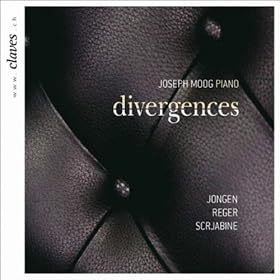
"Divergences" - piano music of Jongen, Reger, Scriabin
Joseph Moog
[Claves]

File under "Who knew?" Well, obviously I know Scriabin, but I didn't know that the 2nd movement of his Piano sonata no.4 from 1903 was at times alarmingly close to being a jazz number. This disc very nearly slipped under the radar but got some very high praise from some quarters as I was putting the final touches to the NGAs; it almost made it as a runner-up. Joseph Moog by all accounts seems to be a pianist to watch. The link between the three composers here is that they were all born around the same time (1872/73) - but in musical terms they diverged. The Belgian Joseph Jongen comes across as a rhapsodic romantic with hints of Debussy in the 3 pieces here. "Soleil à midi" from his op.33 has an especially memorable theme to it. The German Max Reger is well-known (notorious, you might say) for his love of counterpoint and of course his "smallest room in the house" response to a critic. Träume am Kamin is a quite charming set of miniatures, not what I was expecting as I haven't warmed to Reger in the past. This album was an education, and a good one at that.

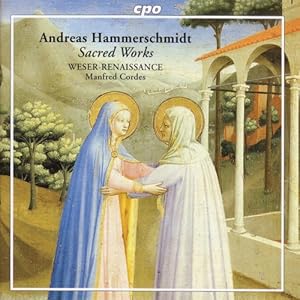
Hammerschmidt: Sacred works
Weser-Renaissance/Manfred Cordes
[CPO]

And what I learned here - or rather, what I learned before I decided to get this - was that Andreas Hammerschmidt was, as Grove puts it, "the most representative composer of mid-17th-century German church music, of which he was a prolific and extremely popular exponent". To me, he was just a name in a list of composers whose anniversary falls this year. Or next year: he was born in either 1611 or 1612. So, if he's Germany's Most Representative, I should listen to him, shouldn't I? Even if, according to Wikipedia, Manfred Bukofzer (never heard of him, either) said Hammerschmidt "watered down the achievements of Schütz for the multitude". Ah, musicologists are a snobby bunch. I like these pieces, 7 from Hammerschmidt's 1649 collection Motettae unius et duarum vocum and 9 from the 1662 set Kirchen und Tafelmuzik. All the latter pieces are in German, as is one of the earlier pieces, the rest being Latin. There's good variety here in the mixing of works and the range of voices employed. So, get this, unless you don't like the idea of watery Schütz.

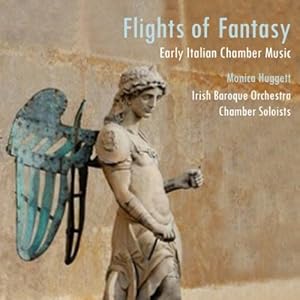
"Flights of Fantasy: Early Italian chamber music"
Monica Huggett; Irish Baroque Orchestra Chamber Soloists
[Avie]

One of those Baroque albums that you know after 15 seconds you're going to enjoy. Full of life and good humour, as I think we are entitled to expect from Monica Huggett. Farina's Capriccio Stravagante is something I haven't heard before, which I now realise from browsing the web makes me a pathetic loser because apparently it's very well known and anyone who knows anything about Baroque music - anything at all - has heard it. Anyway, it's a quarter-of-an-hour piece with various violin effects including animal noises. About 12 minutes in on this recording it goes completely mental, I guess in imitation of yowling cats although the effect strikes me as if the musicians are trying to cope with the score melting before them, notes sliding down staves and onto the floor. Fortunately they recover their poise. And I have heard Biagio Marini's gorgeous Passacaglia before, so there.

Friday, February 11, 2011

So, what changed?

American Record Guide's Donald Vroon is very enthusiastic about Naxos's release of Sibelius's Symphonies nos.1 and 3, performed by the New Zealand Symphony Orchestra under Pietari Inkinen:
"...a wonderful conductor... He is Finnish; he understands that Northern icy temperament. But he is young, and he feels the music - it's not old hat to him yet, not just another Sibelius symphony. It's still fresh, and he still enters into it with his whole heart and gives it everything he's got - which is a lot. ... If the strings aren't quite lush enough to bring me to tears, they are still very beautiful - and the same goes for the wind solos... All [Inkinen's] conducting is faultless and admirable on this release."
I read that and thought, wait a minute, I remember something I posted last year... And yes, this is the same New Zealand Symphony Orchestra under Pietari Inkinen that recorded a previous Sibelius disc of which the same Donald Vroon said:
"This is a very boring orchestra, with no tonal allure. The conducting is dull as well."

Tuesday, February 8, 2011

Empty chamber?

I'm intrigued by something I read in this month's Editorial in International Record Review:
Of the seven Outstanding nominations this month four are chamber discs. I find this particularly interesting because there now seem to be fewer discs released in this genre than previously and sometimes it's a struggle assembling a 'respectable' section in this category.
That's something I hadn't noticed. Is it true? A quick look at my trusty spreadsheet suggests that of IRR's reviews of new releases, about 35% are Orchestral, about 18% Chamber, about 17% Instrumental, about 19% Vocal, and about 10% Opera. Doesn't sound like chamber music's any worse off than other types of music.
As a comparison, American Record Guide reviews break down as about 36% Orchestral, about 19% chamber, about 20% Instrumental, about about 18% Vocal, and about 7% Opera. Oh, let's do Fanfare as well: about 41% Orchestral, about 23% Chamber, about 18% Instrumental, about 13% Vocal, and about 5% Opera.
So, perhaps there are fewer chamber discs released than there used to be - I don't know - but it looks like it should be no harder to assemble a 'respectable' selection of chamber music discs than one of instrumental or vocal ones.

Saturday, February 5, 2011

From the week's listening

First I should note that as of this month my music buying habits have changed radically. You'll have noticed that I'm able to provide excerpts from all the Award winners and runners-up for the 8tracks mixes. This is because last year I was basing my buying around the Awards contenders. Given that 70 albums made the final cut, and there were many more actual contenders, such a practice is possible only if you're very wealthy or if you still have an incredibly cheap eMusic subscription. So for the past year I've largely been getting albums that are "supposed to be good" rather than ones I myself might like. It sounds quite an obligation when put like that and towards the end I probably could have done without the self-imposed pressure to immediately fill the gaps, but in fact there's not a single album I'm not glad to have. Some more so than others, of course, and the thing is, the full set is almost literally a selection voted by committee, rather than one person's idiosyncratic choices. So, Awards out of the way, I said enough of that, time for a change. As of February, I'm back to a rigid, self-imposed program of freedom. And the first fruits of this new policy are...

"The Black Dragon"
Cançonièr

And I should point out straight away that I'm still paying close attention to reviews, but on the individual rather than collective level. I doubt very much if this particular release will end up in any putative 2011 Awards, or even be reviewed in more than one of my sources. It's the sort of release that really only Fanfare and ARG cover - self-published, unusual repertoire - and indeed it was in the latest issue of Fanfare that I found an interview with members of this California-based medieval ensemble (web site here). The album has an intriguing premise - music from the time of Vlad ("Dracula") the Impaler. It kicks off with part of the epic anti-Vlad propaganda poem "Von ainem wutrich der hies Trakle waida von der Walachei", and ends with another bit (the whole poem has over a thousand verses, apparently, most of them detailing his various impalings and other real or imagined barbarities), and there's some folk tunes from Hungary, Romania and the like thrown in, but overall it's a wide-ranging recital, covering a lot of ground from Turkey to France. That variety - reflected also in the selection of vocal versus instrumental pieces - stands it in good stead, as it avoids the sameyness that can sometimes affect even the best of these sorts of themed albums. I'm clueless about how medieval music should be performed, but Cançonièr seem to know what they're doing, and it's all thoroughly enjoyable. Dare I say, an album of medieval music for people who are afraid of albums of medieval music.

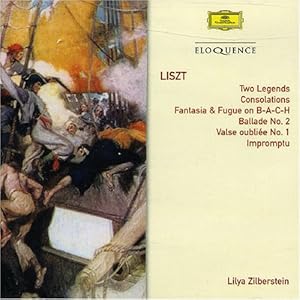
Liszt: Two Legends; Consolations; etc.
Lilya Zilberstein
[Eloquence]

Of course I've previously mentioned this one's ye-scurvy-dogs cover, but what of the music? Honestly, and this is just me speaking, you understand, if I had a choice between just this one Liszt album and every single album ever recorded of Chopin and Schumann, there wouldn't be much hesitation. Your mileage, as they say, may vary. Yes, yes, I know there's a Chopin influence to be heard here anyway, but the simple fact is that Liszt (at least, in works such as the ones here) pushes my "piano" buttons in the same way Mahler pushes my "orchestra" buttons. Warm fuzzy feelings abound on this album. A bloody good start to my Liszt Year.

Whitacre: "Light & Gold"
The Eric Whitacre Singers; Laudibus/Eric Whitacre; and others
[Decca]

Not quite my first exposure to Whitacre's music but very nearly. He's so dishy! I might hate him if his music weren't so lovely. Not everything here is as good as everything else, but the best is very good indeed. There's more variety here than I feared - it's not all serene and beautiful crowd-pleasers like Lux Aurumque and Sleep. I could have done without a rather twee moment in Five Hebrew Love Songs that sounds like it's straight from the worst Franco Zeffirelli film imaginable, but overall the album makes a very favourable impression. Do you know the story of the piece Sleep? Whitacre was commissioned to set Robert Frost's "Stopping by woods on a snowy evening", which he duly did, to much acclaim. Then the Frost estate told him he wasn't allowed to use the poem until it entered the public domain in 2038. Not too keen on waiting that long, Whitacre got his sometime collaborator Charles Anthony Silvestri to write a new poem with the same structure and some of the same words. End result: a much-loved choral classic, and the Frost estate come across as a bunch of dicks.

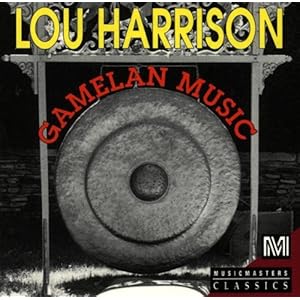
Harrison: Gamelan music
Gamelan Si Betty, with various soloists and the Berkeley Chamber Singers
[Music Masters]


Ever since I heard his gorgeous Air for the Poet, Lou Harrison's been one of those composers I keep meaning to hear more of but never get around to. Finally, I get this one, originally on Music Masters but now also part of a 4-disc reissue on Nimbus. The first piece, Philemon and Baukis for gamelan and solo violin, has that flowing lyricism that so attracted me to Air for the Poet. Not all the album is as comfortably beautiful as that, though: in Gending Alexander, the gamelan is perhaps at its most "exotic", reminding the listener that there are some sounds that Western ears must take time to get used to. The longest piece on the album is the multi-movement Homage to Pacifica, which uses a singer, chorus, and speaker to address how America has treated its environment and its original inhabitants. It includes, weirdly, a movement called "In Honor of the Divine Mr. Handel", which makes use of a harpist and sounds like a Handelian music-box. In "Litany", the choir and speaker chant the names of various Native American groups, the (marvellously stentorian) speaker concluding with the words "all the fine people on this original, natural land: Screwed".

Thursday, February 3, 2011

NvM 7: Songs of a Wayfarer

I see that four months have passed since the last "installment" of this series, and it was four months before that that I actually listened to the music under discussion here.
We're talking about Mahler's song cycle Lieder eines fahrenden Gesellen - Songs of a Wayfarer. Or Songs of a Wayfaring Lad as some translations have it. Or indeed, Songs of a Driving Associate according to Babel Fish. This was his first proper song cycle. He wrote it with piano accompaniment around 1885 and orchestrated it nearly a decade later, but in fact he always had it in mind as an orchestral work. There are 4 songs, and I suppose you could call it a rather compact Winterreise.
The first song - they all have Mahler's words, by the way - is "Wenn mein Schatz Hochzeit macht" ("When my love becomes a bride"), and it immediately sets a dark tone. It has a folksy feel to it, as does much of the cycle. Here the singer's contemplating his loved one's wedding day - not to him, obviously - and although he seems to find consolation in nature things don't work out that way: "spring is dead and gone./Singing's done for ever now".
By the second song, though, he's cheered up a bit: "Ging heut' Morgen
übers Feld" he sings, describing the lovely things he saw on his morning jaunt in the countryside - which lasts almost all the way through the song before he realises that his life is still, at bottom, miserable.
"Ich hab' ein gl
ühend Messer" is full of rage and despair, with plenty of "O weh!"s as he sings of the pain and torture he's being put through. It culminates in the singer wishing he were dead.
And does he get his wish? Perhaps. The final song, "Die zwei blauen Augen", sees him appear to pull himself together somewhat, as he leaves town in the dead of night. By and by he finds a linden tree, so beloved of Romantic poets, under which he lies down and... well, it really depends on who you listen to. Perhaps he has embraced death, or maybe it's just that, alone in the great world, he has finally found peace. Either one is possible, and it's fascinating hearing how subtle differences in performance can push it one way or the other.

I decided to start my listening with recordings of the piano version - this was the original version but the orchestral version from the early 1890s is seen as the "definitive" one.
Christian Gerhaher, Gerold Huber (RCA). Hey, this recently won a Nereffid's Guide Award! I was very pleased with that, as it's an excellent album, and Gerhaher's voice is a wonderful thing. I suppose this is a slightly low-key performance, certainly compared to others. In "Ging heut", for instance, he's cheerful rather than exuberant, and then towards the dark end of the song he hangs on to optimism for as long as he can, and there's a sense of sad acceptance in his realisation that happiness won't be coming his way. The third song's opening feels oddly like one of Schubert's "riding" songs - lovely clear piano from Gerold Huber - rather than a personal apocalypse. If this all seems like the performance isn't quite up to scratch, I should be clear that it very much is up to scratch, as it's full of character. The final song promises something valedictory as it opens, and as the wayfarer approaches the linden tree there's a touch of optimism, and the song ends in peace - and yet there's something unsettling about the final piano notes.
Janet Baker, Geoffrey Parsons (Hyperion). There's a tragic quality to Janet Baker's voice right from the start; though the second verse of the first song can have some cheer to it, here she sings plaintively, and there's a weary sadness through the whole thing. This sort of tone doesn't suit the second song, though, I think, and it feels rather undercharacterized. I like the third song, though, and the fourth does have character - but unlike Gerhaher, Baker seems to have given up. This one ends like a lullaby, but again that piano coda throws a spanner in the works - it gives the story an unfinished feel. I'll have more to say about Janet Baker later on.
Christoph Prégardien, Michael Gees (Hänssler). Having had a baritone and mezzo, we now turn to a tenor, which is not usual but isn't something that bothers me. It's possible that Prégardien and Gees's performance would bother some people; right from the start there seems to be a little messing with tempos and rhythms. Perhaps more worrisome might be Prégardien's style in the opening number - I wouldn't quite call it "detached" but he doesn't seem to be living the words. And the second song also appears mannered, as if he's reciting poetry about nature rather than actually being out in it - a touch of the drawing room to the whole thing. Yet I found the clarity of his voice rather made up for this apparent lack of engagement. Ah, but then... the final lines of this song seem to mark a major change, and the emotional level rises immensely - most certainly when they launch into "Ich hab'ein glühend Messer". Perhaps Prégardien did fail to be engaged in the first couple of songs, but it seems to me that the lack of engagement is deliberate. Here's a man who, as the cycle begins, simply doesn't realise what he's in for. Not quite Eugene Onegin, perhaps, but he comes across in the first song as someone who's quite prepared to get over this romantic setback. Song two, it's "See? For example, I can now go and appreciate Nature" - but suddenly everything hits him in the gut, and he's not OK. Song three is his explosion of pain, and song four - well, song four is where he finds a way out. He gathers his dignity but he's no longer the same person. He takes his leave, almost like a soldier (and indeed Gees's accompaniment is rather reminiscent of other of Mahler's songs that have a military component). The singer has embraced his fate, and at the linden tree he finds great peace. But there's a slightly more intense pulse to this than we've heard in the other performance, like he's being dragged willingly forward to his end. Here, the final piano notes sound like a memory. I really like this recording.
Angelika Kirchschlager, Helmut Deutsch (Quinton). Of the four voice-and-piano recordings here, this is by a long way the most beautiful to listen to, as Kirchschlager has a lovely clear voice that really rings out. On eMusic, from which I downloaded this, someone has reviewed the album saying "these songs were created by Mahler and Angelika's singing morphs them into the perfect Lieder", and actually I think that praise highlights something that's unfortunately not quite right about the performance, to my ears at least. In a way, these four songs aren't lieder - the cycle is rather more than the sum of its parts, but my impression of Kirchschlager's performance is that these are, indeed four individual lieder. It doesn't feel like a journey, basically. Everything is pretty much in its right place, but to my mind a lot of it needs a little tweak - darker, usually but not always - if the whole thing is to hang together. I suppose the problem is that it sounds so lovely, but there are moments when less loveliness is required. For all that, though, I do like it. I mean, it is so lovely! But for something more, I must stick with Gerhaher and Prégardien. And... but let's wait for another day before we get to the orchestral versions.
8tracks mix: Awards 2010, part II

Here's the second selection of winners and runners-up in the Nereffid's Guide Awards, this time from the Solo instrumental and Chamber categories.


(side note: I have 21 followers on 8tracks now - yay!)

Review of the year (Mean-spirited category)

German musician Ludger Rémy and (two members of) his orchestra Les Amis de Philippe were one of the runners-up in this year's Nereffid's Guide Awards, for their recording of trios by the Graun brothers. Part of the reason for that was a recommendation from Bertil van Boer in Fanfare. Indeed, that magazine's reviewers have been well disposed toward Rémy over the years, with praise going to discs of cantatas by Telemann and CPE Bach, arias by Theile, and concertos by Manfredini. Even Jerry I-hate-period-instruments Dubins was bowled over by a collection of music by Fasch. So when Rémy and his group's latest CPO recording - more CPE Bach cantatas - shows up for review in Fanfare you might have expected more of the same.
Fuck, no.
Here's what self-proclaimed "CPE Bach fan" Lynn René Bayley had to say about it:
Perhaps my reaction to these works would be more positive if the performances were actually good. Unfortunately, they are performed in a clipped, crispy-crunch style where neither the strings nor the chorus phrase in a legato manner. Some of the soloists do sing with a sense of legato, but more so the basses than the sopranos or tenors. Indeed, both the female soloists and the chorus sound as if they were “vocal effects” produced on a MIDI.

Okay, hyperbolic last sentence perhaps, but otherwise not unreasonable criticism. Fair enough, she didn't like the performances.
But then:
It’s rather disappointing to consider that conductor Ludwig Rémy, who appears to be a middle-aged man, could have made it this far in life without the least shred of feeling for music. I would suggest that he find another, nonmusical, line of work. I’m sure he’d make a fine electrical engineer or chartered public accountant.

Jesus.

Wednesday, February 2, 2011

Well, I think it's just arrogant

You would think, wouldn't you, that if you were a publication called BBC Music Magazine you would be quite content with the web address bbcmusicmagazine.com, no? I mean, it makes sense. It describes the purpose of the web site rather well. Perhaps you could quibble that it should be bbcmusicmagazine.co.uk, but other than that it does the job.
But that's not good enough, is it? Because "the world's best-selling classical music magazine" isn't content with just being the world's best-selling classical music magazine - which means what, anyway, just that maybe more people buy it than commit murder. Oh no, so-called B so-called B so-called C so-called Music so-called Magazine has loftier ambitions than that and now the web site is classical-music.com. World domination beckons! Because now the magazine is up there with its unhyphenated brethern: gibberish extravaganza classicalmusic.com and classicalmusic.co.uk, which is apparently home to The Escape Committee: Gamekeeper to the web rhino.
So now when we think of classical music on the intertubes we must think of BBC Music Magazine. This will end in tears, I know it. After all, anyone who believes everything that Universal Music Group tells them will be aware that "Deutsche Grammophon is classical music". Could this be the opening skirmish in a war for the very soul of classical music? I'm absolutely convinced it must be. I think we can safely assume that at some point in the future our corporate overlords will rule that someone somewhere does indeed have the rights to the use of the term "classical music", just as the U.S. Olympic Committee has exclusive ownership of the adjective "Olympic".
In the meantime, let me conclude this ill-conceived diatribe by remarking that on the old bbcmusicmagazine.com you could log in without going to a separate page, and on the new classical-music.com you can't. Swine.