
Friday, April 16, 2010

Sunday, April 11, 2010
Straight in at number 98
So, BBC Radio 3 is to broadcast the official classical album chart now. It will challenge "crusty old preconceptions", according to Rob Cowan, who by the sounds of it is gradually turning into dodgy classical huckster Les Introuvables. "Never mind the quality, feel the length!" Or, as Homer Simpson might say, "mmm... crusty old preconceptions...". Meanwhile, Sara Mohr-Pietsch says "I'm looking forward to exploring the chart, and sharing my personal reflections on new arrivals and enduring bestsellers with Breakfast listeners". I wonder will those "personal reflections" include "Oh for fuck's sake, not fucking André fucking Rieu again"? In fairness though, the Specialist Classical Chart is a respectable-looking thing, and Rieu's the only one on the current chart who's unlikely to grace the pages of your favourite CD review magazines. But that's not the point, is it? This is Radio 3.
Which segues us neatly to Classic FM, and the latest Hall of Fame. Yes, another list. This one at least has the merit of comprehensiveness, with 300 entries. I have a fondness for the Hall of Fame, I admit, which stems mostly from the fact that it's been going since 1996 and I can have fun comparing years. (Yes, every year I put the new data into a spreadsheet... this nerdlike behaviour stemmed from years ago when I wanted to use the chart for guidance in making some "popular classics" compilations). Mrs Nereffid suggests you could - given enough years of it - use it to construct some sort of "social history of classical music". I'm not sure you could go that far; "idle speculation" is probably more like it. For instance, why is Bruch's violin concerto no.1 not as popular as it used to be? (It was #1 for the first 5 years, now it's down to #10) And, why is Debussy's Clair de lune more popular than before? Why is that staple of long ago, Dukas's The Sorcerer's Apprentice, never in the list? Also, how did Berg's violin concerto sneak in at #210 two years ago, only to disappear immediately? And why did Vaughan Williams suddenly become more popular in 2008? That's an easy one, of course - his anniversary in 2007. But why (on Earth) did Malcolm Arnold's The Padstow Lifeboat appear out of nowhere this year, straight in at number 98?
Which segues us neatly to Classic FM, and the latest Hall of Fame. Yes, another list. This one at least has the merit of comprehensiveness, with 300 entries. I have a fondness for the Hall of Fame, I admit, which stems mostly from the fact that it's been going since 1996 and I can have fun comparing years. (Yes, every year I put the new data into a spreadsheet... this nerdlike behaviour stemmed from years ago when I wanted to use the chart for guidance in making some "popular classics" compilations). Mrs Nereffid suggests you could - given enough years of it - use it to construct some sort of "social history of classical music". I'm not sure you could go that far; "idle speculation" is probably more like it. For instance, why is Bruch's violin concerto no.1 not as popular as it used to be? (It was #1 for the first 5 years, now it's down to #10) And, why is Debussy's Clair de lune more popular than before? Why is that staple of long ago, Dukas's The Sorcerer's Apprentice, never in the list? Also, how did Berg's violin concerto sneak in at #210 two years ago, only to disappear immediately? And why did Vaughan Williams suddenly become more popular in 2008? That's an easy one, of course - his anniversary in 2007. But why (on Earth) did Malcolm Arnold's The Padstow Lifeboat appear out of nowhere this year, straight in at number 98?
Saturday, April 10, 2010
Heads... tails...
 Let's say you wanted to know whether this recording of Brahms' Piano sonata no.3 and Waltzes op.39, by Antti Siirala on Ondine, is worth getting. Well, you could consult Jed Distler on Classics Today, who says of the sonata "Antti Siirala doesn't interpret Brahms' F minor sonata so much as he defoliates it. Scrupulous to a fault, Siirala irons out the music's craggy contours, takes great pains to extract hidden counterpoints, and tapers phrases to microscopic levels of calibration. The results soften the rhythmic impetus of bass lines and pedal points (especially in the first two movements) and miss Emanuel Ax's sonorous warmth and textural variety, to say nothing of Arthur Rubinstein's impetuous ardor. Both Murray Perahia and Clifford Curzon replicate Siirala's sharply articulated dotted rhythms in a more congenial, vocally oriented context, with infinitely more color." So, no, then. Well, let's see what Jerry Dubins said in Fanfare: "Training the fingers to play the notes is only half the battle. The other half is making sense of them. Here is where Siirala really impresses me... Siirala is a powerhouse of technical reserve; the richness, fullness, and solidity of his tone are visceral, helped by a superbly detailed recording. But as important, perhaps more important, is that in his hands what Brahms wrote suddenly sounds right. All of the pieces of the puzzle fit together. This is no small accomplishment". Huh. OK, then, the answer's yes.
But wait... what about the Waltzes? Well, Distler says "Fortunately, Siirala kicks up his dancing boots for the Waltzes, allowing their charm, swagger, and ingenuous cross-rhythms full due". Cool! Sounds like fun. Wait... what's that, Jerry? "Barely disguised in these lilting melodies is all of the angst, the loneliness, and the sense of isolation Brahms felt throughout his life and communicated with such vulnerable intimacy... Young as he is, Siirala understands this vulnerability; you can hear it in his playing."
Oh for goodness' sake! Did you two even listen to the same CD?
Kuhnau
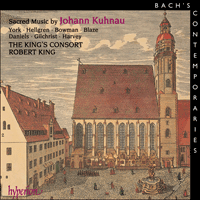 Last Tuesday was the 350th birthday of Johann Kuhnau, and by a sort-of coincidence I happened to be listening to this album of his music on that day. Sort-of coincidence because I didn't know it was his birthday, but I did know it was his anniversary year. Last week, I happened to come across his name in a notebook I kept many years ago (post on that to follow. It won't be worth the wait). That reminds me, I thought, I must get that Kuhnau album. So I did. Then it turned out it was his 350th birthday on Tuesday.
The CD is currently out of print, but you can download the album from Hyperion for £7.99. Worth every penny and then some, I'd say. This is thoroughly enjoyable stuff, chock full of tuneful chorales, lyrical arias, lively trumpets and drums... the sort of music that makes you very glad. Grove says "Critical opinion... has generally dismissed the cantatas as routine and uninspired, though competently composed. Such judgments are not borne out by the music itself". (Or, as Edmund Blackadder might say, there was only one flaw in that critical analysis: it was bollocks.)
Kuhnau died in 1722, and his post as Kantor at the Thomasschule in Leipzig was taken by some guy called Sebastian something.
Wednesday, April 7, 2010
Another stupid list from RTÉ
I pay my TV licence fee every year, you know. Anyway...
Ireland's Greatest Top 10 is revealed. Who do "we" think are "Ireland's greatest figures"? Oh who cares. I can't go on.
I'll go on. The original list of 40 has, by public vote, been whittled down to 10. And in alphabetical order they are:
Bono
Noel Browne
Michael Collins
James Connolly
Stephen Gately
John Hume
Phil Lynott
Padraig Pearse
Mary Robinson
Adi Roche
The ten now have the honour of having an RTÉ documentary made about them in which they will each be championed by a "well-known personality".
Monday, April 5, 2010
How much do you love Holmboe?
Intriguing little news item on Danish label Dacapo's web site: Volumes 1 and 6 of the label's set of Holmboe string quartets had been out of print for a while. You can download both from the site for €11 each, or get the CDs now for €13.50, but there's a new copy of Volume 1 available through Amazon for $195!
Who are these people to whom a CD could be worth that much?
Who are these people to whom a CD could be worth that much?
Friday, April 2, 2010
Review of the month
American Record Guide really doesn't hold back sometimes. This is from Allen Gimbel's review of James Tenney's Spectrum Pieces, performed by The Barton Workshop on New World Records:
"Tenney found his earlier spectral pieces "too sweet" since they acknowledged the lower reaches of the harmonic series and thus had an aura of "tonality" about them. These pieces are more macho and don't bother with such old-fashioned gentility. Any notion of recognizable musical patterning is also thrown out the door, as is any semblance of musicality.
... 1 is for a septet... Random unkempt (oh, excuse me, "properly tuned") pitches meander tediously from one to the other... 2 is for a quintet... Listen at your own risk... 5, an octet... is filled with some of the most unrelievedly foul sounds I've ever heard on records... Finally, 8... Like everything else on this program it is thoroughly unlistenable.
Tenny had built a reputation as one of the avant-garde's most underrated and important figures, and for such an audience this release would be considered important as "Late Tenney"; but for the rest of us (that is, not his friends) this music is of negligible value and is in fact considerably worse than that."
Thursday, April 1, 2010
Inside the mind of Lyric FM
Lyric FM - sorry, RTÉ lyric fm - is seeking our votes for its "Top 100": "Who is your favourite tenor or soprano? Which composer do you enjoy the most? What is your most loved movie soundtrack?" My first reaction to this survey is to think of Dr Johnson's dog walking on its hind legs. Actually I'm not surprised that it's done at all - it's an entertaining way for station bosses to get an idea of who their audience is. I wonder how long it took them to come up with the 10 choices for each of the categories. I hope it was a long, difficult process filled with passionate argument that eventually produced a list that all parties were satisfied with. It can't be easy to pick just 10 sopranos or whatever, especially when you also have to make a token or otherwise nod to Irish performers. Then again, the list of symphonies looks like it chose itself - Saint-Saens 3, Mozart 41, Beethoven 9, Mendelssohn 4, Dvorak 9, Schubert 8, Haydn 101, Berlioz, Tchaikovsky 5, Mahler 5 - pretty much a "usual suspects", but how did they settle on Haydn's "Clock" over any others?
And yes, Karl Jenkins made it to the list of favourite choral works. And yes, there is a "favourite soundtrack" list but not a "favourite chamber work" list, which I think says a lot about where Lyric - sorry, lyric - is coming from. This is, after all, the station that gave George Hamilton a job. I'm not sure what to think about the "favourite orchestra" list; on the one hand, those who have an opinion on, say, Berlin versus New York have a certain kind of specialised knowledge, but on the other hand would those same people regard the Boston Pops or RTECO as being eligible for the same list? (I don't know; I'm not a "favourite orchestra" kind of listener so the whole thing is moot to me)
In the end, the Top 100 will probably just be an excuse to play some popular music on May 3rd, and it won't have any other meaning or implications. But until then, we can dream of Andrea Bocelli getting zero votes, and Anton Webern emerging as Ireland's favourite composer. Vote early and often!
And yes, Karl Jenkins made it to the list of favourite choral works. And yes, there is a "favourite soundtrack" list but not a "favourite chamber work" list, which I think says a lot about where Lyric - sorry, lyric - is coming from. This is, after all, the station that gave George Hamilton a job. I'm not sure what to think about the "favourite orchestra" list; on the one hand, those who have an opinion on, say, Berlin versus New York have a certain kind of specialised knowledge, but on the other hand would those same people regard the Boston Pops or RTECO as being eligible for the same list? (I don't know; I'm not a "favourite orchestra" kind of listener so the whole thing is moot to me)
In the end, the Top 100 will probably just be an excuse to play some popular music on May 3rd, and it won't have any other meaning or implications. But until then, we can dream of Andrea Bocelli getting zero votes, and Anton Webern emerging as Ireland's favourite composer. Vote early and often!
Wednesday, March 31, 2010
Everything in its right place
 Who on earth buys CD shelves these days? Me. At last I've reached the shelves-covering-one-whole-wall-of-the-room phase. Well, OK, not the whole wall because the door opens against it. But still. And removing all the CDs from where they were stacked on bookshelves means I can now put actual books on the bookshelves. It's quite clever really.
Concert held; no one dies
A performance by the Jerusalem Quartet at "London's Wigmore Hall" on Monday was repeatedly interrupted by pro-Palestine/anti-Israel demonstrators. News reports here and here; the view from one of the protesters here; and an eye-witness account/concert review here.
One thing puzzles me. On the one side, there's a claim that one or more members of the Jerusalem Quartet are part of the West-Eastern Divan Orchestra. On the other, there's a claim that the quartet are Distinguished IDF Musicians. Surely both can't be true. Wouldn't that require some serious cognitive dissonance? Or is the Israel-Palestine situation even more fucked up than I thought?
One thing puzzles me. On the one side, there's a claim that one or more members of the Jerusalem Quartet are part of the West-Eastern Divan Orchestra. On the other, there's a claim that the quartet are Distinguished IDF Musicians. Surely both can't be true. Wouldn't that require some serious cognitive dissonance? Or is the Israel-Palestine situation even more fucked up than I thought?
Tuesday, March 30, 2010
Wikipedia at its best
For reasons that we don't need to go into, I've just been consulting Wikipedia about the flag of Nicaragua. The text of the "stub" article concludes with:
NONE OF THIS IS TRUE
Tuesday, March 23, 2010
Penderecki for the criminally insane
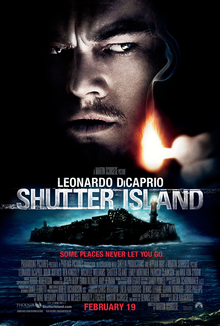 It's an intriguing thought, that millions of cinema-goers are currently getting their first taste of the music of composers such as Schnittke, Cage, Scelsi, and Feldman. This is thanks to the soundtrack of Martin Scorsese's latest, Shutter Island, which features a variety of modern classical pieces rather than a specially composed score. The movie's a conscious effort to pay homage to forties B-movies, which of course means it's smarter, better put together, more emotionally engaging, and possessing of a deeper insight into the human condition than most big movies. OK, I admit I'm not neutral when it comes to Scorsese. With Shutter Island, we've got a film that a lot of directors could have pulled off pretty easily, but Scorsese brings that much more to the table, and manages to make it something other than just a couple of hours' cheap thrills. The music is certainly a major part of his success; hats off to Robbie Robertson, who chose the music and in a press release said "This may be the most outrageous and beautiful soundtrack I’ve ever heard". Not being a soundtrack afficonado, I can't instantly agree with him. But I think he's right. Saw the film Saturday evening, bought the soundtrack Sunday morning.
The first stroke of genius is the choice of Penderecki's Symphony no.3 - the repeated low notes that begin the 4th movement set the ominous tone as the two federal marshalls approach the island. Very Bernard Herrmann, really. This music returns repeatedly throughout the film - you might call it the main theme, or one of them at any rate. Much of the subsequent action is underscored by music that's variously sinister (Cage's Music for Marcel Duchamp), spooky (Feldman's Rothko Chapel), and disturbing (Scelsi's Uaxuctum: The Legend of the Mayan City Which They Themselves Destroyed for Religious Reasons). The second stroke of genius is what's playing on Max von Sydow's turntable. "What is that? Brahms?" asks Mark Ruffalo. "No. It's... Mahler", Leo diCaprio replies, heralding a flashback to... well. Yes indeed it is Mahler, specifically the piano quartet movement he wrote as a teenager. OK, slight mistake on the part of the film makers here - the work had its first known performance several years after the events of the film - but the music is so good that you forgive this (in fact, I'd only heard the piece for the first time about a month ago, so I too had a "What is that?" reaction).
The third stroke of genius is one that most of the audience on Saturday chose to completely avoid, because they left the cinema as soon as they possibly could when the credits began to roll. I don't understand this sort of behaviour. I see it all the time, regardless of the film. OK, maybe a few of them had a bus to catch, but can they not have even a moment's pause before charging off? Maybe the film meant nothing to them - literally meant nothing, because it takes more than a second to digest the film's final line. Anyway, the credits rolled, Mahler played again, and then what these fools missed was an extraordinary "remixed" version of Dinah Washington singing "This Bitter Earth", her vocals (slowed down from the original?) laid over a haunting string work by Max Richter called "On the Nature of Daylight". I'm inclined to believe that the people who left the cinema quickly didn't actually attend the whole film.
Wednesday, March 17, 2010
Thursday, March 11, 2010
Why was I not told about Uuno Klami?
I've been listening to the music of Finland's Uuno Klami (1900-1961) for the first time, specifically a selection of 5 pieces recorded for Ondine by Sakari Oramo and the Finnish Radio Symphony Orchestra, downloaded as part of my recent "get a whole bunch of cheap stuff I don't know" campaign. I suppose I could blame myself for the fact that I'd never heard Klami's music before, but it's more fun to blame society instead. After all, it's not as if there are new Klami albums coming out every month... he only gets half a page in my 1980 Grove... what the hell is wrong with you people?
Actually there is a new Ondine recording out, which I shall have to get. David Hurwitz reviewed it on Classics Today, saying Klami's music is "characterized by superb craftsmanship, glittering orchestration, and melodies that sound like you might have heard them before but can't remember where", which I agree with on my limited listening experience. Yes, you can hear Sibelius in there somewhere (would it be any other way for a Finnish composer inspired by the Kalevala?) but I also detected some early Stravinsky in there and, somewhat puzzlingly, Ravel. Grove reveals that Klami studied with Ravel, and indeed a quick skim through various online reviews shows that it's standard operating procedure to call Klami "the Finnish Ravel", as Hurwitz does.
Of the 5 things I listened to, the Karelian Rhapsody of 1927 is the stand-out. It's got a sort of bipolar nature to it, spending a lot of its time in northern gloom but every so often bursting out in rustic giddiness. As for melodies I might have heard before, I got "The loveliest night of the year" and "From the halls of Montezuma". Go figure. Another work on this album is In the Belly of Vipunen, with baritone and chorus, which (I presume) recounts an episode from the Kalevala in which Väinämöinen is swallowed by the giant Vipunen, builds a forge in his stomach, and generally makes a nuisance of himself until Vipunen reveals a secret incantation.
I admit I'm kinda proud of myself for spotting Klami's influences all by myself on first listen. Look at this: Gramophone - "He preferred Ravel and Stravinsky as stylistic godfathers"; MusicWeb - "Klami drank deep draughts of the Finnish nationalist essence but later mixed it with the voices of Gallic impressionism and Stravinskian energy from his studies in Paris"; Gramophone again - Klami "escaped the overbearing dominance of Sibelius's style only to "fall for the intoxicating draughts of Ravel, early Stravinsky and Florent Schmitt"". Draughts galore!
Actually there is a new Ondine recording out, which I shall have to get. David Hurwitz reviewed it on Classics Today, saying Klami's music is "characterized by superb craftsmanship, glittering orchestration, and melodies that sound like you might have heard them before but can't remember where", which I agree with on my limited listening experience. Yes, you can hear Sibelius in there somewhere (would it be any other way for a Finnish composer inspired by the Kalevala?) but I also detected some early Stravinsky in there and, somewhat puzzlingly, Ravel. Grove reveals that Klami studied with Ravel, and indeed a quick skim through various online reviews shows that it's standard operating procedure to call Klami "the Finnish Ravel", as Hurwitz does.
Of the 5 things I listened to, the Karelian Rhapsody of 1927 is the stand-out. It's got a sort of bipolar nature to it, spending a lot of its time in northern gloom but every so often bursting out in rustic giddiness. As for melodies I might have heard before, I got "The loveliest night of the year" and "From the halls of Montezuma". Go figure. Another work on this album is In the Belly of Vipunen, with baritone and chorus, which (I presume) recounts an episode from the Kalevala in which Väinämöinen is swallowed by the giant Vipunen, builds a forge in his stomach, and generally makes a nuisance of himself until Vipunen reveals a secret incantation.
I admit I'm kinda proud of myself for spotting Klami's influences all by myself on first listen. Look at this: Gramophone - "He preferred Ravel and Stravinsky as stylistic godfathers"; MusicWeb - "Klami drank deep draughts of the Finnish nationalist essence but later mixed it with the voices of Gallic impressionism and Stravinskian energy from his studies in Paris"; Gramophone again - Klami "escaped the overbearing dominance of Sibelius's style only to "fall for the intoxicating draughts of Ravel, early Stravinsky and Florent Schmitt"". Draughts galore!
No thumbs up
Ack! MusicWeb has removed the little thumbs-up icon from the review listings. Now I'm going to have to read the damn things...
Galactica: Sabotage
We don't normally cover either TV science fiction or the Beastie Boys here, but...
And there's a shot-by-shot comparison with the original, too.
And there's a shot-by-shot comparison with the original, too.
Wednesday, March 10, 2010
Choose your Figaro
Over on the eMusic boards, a question has been raised by the redoubtable snakespeare about which Nozze di Figaro to download. I know which one I automatically gravitate to, but we all have our particular prejudices (good and bad). So here's some links to samples that will allow us to compare and contrast without knowing who we're listening to. For each of 4 bits from the opera, there's 15 randomly arranged .mp3 samples from 15 Figaro recordings available on eMusic Europe (in a different order for each bit). Answers will appear in the Comments. When I get my PhD in Hard Sums I'll devise a scoring system that will reveal (a) how perceptive a listener you are, (b) how consistent your tastes are, (c) secrets for a perfect love life, and (d) were our ancestors aliens?
Overture:
A B C D E F G H I J K L M N O
Non piu andrai:
A B C D E F G H I J K L M N O
Voi, che sapete:
A B C D E F G H I J K L M N O
Giunse alfin il momento:
(A) B C D E F G (H) I J K L M N O
(the 2 samples in parentheses are for 2 albums that don't start a track with "Giunse alfin..." so in these cases I've used the preceding "Signora, ella mi disse", just for the sake of having something there)
In alphabetical conductor order, these are the albums and their eMusic links:
Bohm; Busch (1934); Busch (1949); Halasz; Jacobs; Karajan (1954); Karajan (1974); Kuijken; Maag; Maazel (discs 2 and 3); Mackerras; Mehta; Parry (in English); Reiner; Rosbaud.
So what I did was listen to each sample in turn and rate each one as "I like it/It's OK/I don't like it", with sound rated as "Good/OK/Poor". Seven recordings proved consistenly likeable, and the others were variable. Call it a bias, but the ones in good sound (generally, modern recordings) usually proved a bigger hit performance-wise than the older (sometimes very obviously live) ones. Jacobs on Harmonia Mundi proved to be my favourite, thus confirming a prejudice! The runner-up was the Naxos recording by Michael Halasz, closely followed by Mackerras on Telarc, (the singers let down a bit by the sound, I thought) then Kujken on Accent, Karajan's 1974 account on Opera d'Oro (though I found the sound quality a drawback), and Maag's on Arts (also not helped by the sound). I liked Parry's Chandos version too, though I'm a little ambivalent about Opera in English in terms of "if you own only one version..."; where would it fit on the list? Possibly between Karajan and Maag. Or possibly not.
These 7 recordings alone can be ranked 5,040 different ways, you know, so I don't expect you to agree with me. Can we make these sorts of decisions based on 30-second samples, anyway? Probably not. Oh well.
Overture:
A B C D E F G H I J K L M N O
Non piu andrai:
A B C D E F G H I J K L M N O
Voi, che sapete:
A B C D E F G H I J K L M N O
Giunse alfin il momento:
(A) B C D E F G (H) I J K L M N O
(the 2 samples in parentheses are for 2 albums that don't start a track with "Giunse alfin..." so in these cases I've used the preceding "Signora, ella mi disse", just for the sake of having something there)
In alphabetical conductor order, these are the albums and their eMusic links:
Bohm; Busch (1934); Busch (1949); Halasz; Jacobs; Karajan (1954); Karajan (1974); Kuijken; Maag; Maazel (discs 2 and 3); Mackerras; Mehta; Parry (in English); Reiner; Rosbaud.
So what I did was listen to each sample in turn and rate each one as "I like it/It's OK/I don't like it", with sound rated as "Good/OK/Poor". Seven recordings proved consistenly likeable, and the others were variable. Call it a bias, but the ones in good sound (generally, modern recordings) usually proved a bigger hit performance-wise than the older (sometimes very obviously live) ones. Jacobs on Harmonia Mundi proved to be my favourite, thus confirming a prejudice! The runner-up was the Naxos recording by Michael Halasz, closely followed by Mackerras on Telarc, (the singers let down a bit by the sound, I thought) then Kujken on Accent, Karajan's 1974 account on Opera d'Oro (though I found the sound quality a drawback), and Maag's on Arts (also not helped by the sound). I liked Parry's Chandos version too, though I'm a little ambivalent about Opera in English in terms of "if you own only one version..."; where would it fit on the list? Possibly between Karajan and Maag. Or possibly not.
These 7 recordings alone can be ranked 5,040 different ways, you know, so I don't expect you to agree with me. Can we make these sorts of decisions based on 30-second samples, anyway? Probably not. Oh well.
Tuesday, March 9, 2010
Philip Langridge
And while we're on the subject of the deaths of musical men, time too to remember the late Philip Langridge.
Thinking about Harmonia Mundi
With the recent death of Bernard Coutaz, thoughts turn to the label he established more than 50 years ago, Harmonia Mundi. I'm trying to remember what was the first Harmonia Mundi album I owned - a difficult task, because I didn't pay much attention to labels back then. It might have been "Musique de la Grèce antique" (links are to Amazon.co.uk). Or maybe not. So I'm not doing this in chronological order. What are some other releases that impressed me before I started to become the collector I am now? Nicholas McGegan's recording of Susanna was a key step in my long-delayed appreciation of Handel - plenty of charm there. My attempts to get into medieval music were greatly aided by the Paul Hillier/Andrew Lawrence-King album of French Troubadour Songs. The key here was the realisation that a recording of medieval music didn't have to be merely a historical document, but could be in its own way as modern as anything else. As if to somehow prove that point, Paul Hillier also was responsible for my first foray into the world of John Cage. What else? Haydn from René Jacobs, Poulenc from Daniel Reuss, Pandolfi from Andrew Manze, "Hamburg 1734" from Andreas Staier, Wolf from Kent Nagano. I suppose by this stage I'd realised that Harmonia Mundi was associated with a certain kind of music ("good" music, perhaps?!), but I still didn't have much of the label in my collection. Blame cost and availability - I wasn't spending much on music at the time, and any given attempt to buy a classical CD in Ireland will be fraught with complications. So I can thank eMusic for broadening my horizons, first with the US arm of Harmonia Mundi, and eventually with the French side too. Some early ear-openers included another from Paul Hillier, Pärt's "Da Pacem"; Richard Egarr playing Mozart on a fortepiano; Joel Frederiksen's "The Elfin Knight" (oh how I love that album); Paul O'Dette playing Dowland; Mendelssohn from the Eroica Quartet; Mark Padmore singing Handel arias. And more. Much more.
So, thank you, Bernard Coutaz and those who have worked with you, for all the beauty and joy you've created.
So, thank you, Bernard Coutaz and those who have worked with you, for all the beauty and joy you've created.
Wednesday, March 3, 2010
Hey Steve Reich...
... my 4-year-old daughter's up on the coffee table, dancing to part 2 of Tehillim. Just thought you should know.
Subscribe to:
Posts (Atom)