Sunday, October 18, 2009

Les Introuvables welcomes you

How hard do you think it would be to send out a basic e-mail advertising this site to a bunch of contacts? If you guessed "not hard at all" then you are utterly wrong. Two attempts, and I screwed up the BCC on the second one. I am so useless.
Let's think happy thoughts instead:

Haydn just confused the hell out of me

I'm listening to the first volume of Ronald Brautigam's complete set of Haydn's keyboard music on BIS. Track 14 just came on and I thought, "wait a second, I've just heard this one!" And yes, track 14, which is the Presto first movement of the Sonata no.5 (11 in the Hob numbers), and track 13, which is the Presto finale of the Sonata no.4 (G1), are identical. Well. I very nearly wrote an outraged missive to Robert von Bahr demanding my money back. But it turns out that's how it's supposed to be - I just checked samples of another recording online. I say to you, Mister Haydn sir, WTF? W T F, sir? Actually it may not be Haydn's fault either. Sonata no.5 is of doubtful authenticity, according to the sleeve notes (although surely we can say the first movement is authentic, if Sonata no.4 is kosher?).

Saturday, October 17, 2009

8tracks mix: Les Introuvables de Nereffid #1

I've been experiencing the joys of 8tracks, a "mixtape" site that allows you to create and listen to user playlists. It's all free and legal, and a great way for me to make public some of the music I've been posting about here. What I'm going to do is, every few weeks I'll create a new 10-track playlist based on the most recent things I've been listening to.
Now, 8tracks has to jump through various hoops to make things legal, such as no mention of the actual tracks in the playlist before you hear them, and a limit on the number of times you can skip to the next track. This is all fair enough. In that spirit I won't give a detailed playlist here either - hey, it's part of the fun of being DJ'd to. To get a reasonable idea of what's in the playlist, all you need to do is look back over the blog. The last couple of weeks' music aren't in this mix - wait till the next one!
The runtime's not much over 40 minutes.


This week I listened to

Chisholm: Piano music
Murray McLachlan
Divine Art


The music of Erik Chisholm can be summed up, not unfairly, in a single word: "McBartok". Which is to say that, like Bartok, he made heavy use of folk tunes and rhythms in his work. Murray McLachlan has recorded several volumes of Chisholm's music, with more on the way. Have a look at John France's thorough review of discs 1-4 on MusicWeb. France says "this eye-opening cycle ... is one of the musical discoveries and revelations of the Twenty-First century". I downloaded a bunch of it from eMusic, mixing from the first 4 discs. So far I've listened to the Straloch Suite, the sonata "An Riobain Dearg", and the first 8 Piobaireachd. All of it's fascinating, and some of it is really good. The very enjoyable suite is based on an early 17th century lute book and as a result is populated with various old tunes, while still being clearly a modern (1930s) work. The sonata, from 1939, is a big work, its most striking movements being the highly propulsive Scherzo and the "Lament for HMS Thetis", a darkly moving piece that refers to a pre-war submarine disaster that killed 99 sailors; it's a vivid piece of water music (well, underwater, really - I don't mean that facetiously; you'll know what I mean when you hear it). The Piobaireachd are all based on bagpipe music, but again modern in nature. I don't think Bartok ever gave any of his works a title like "Maclean of Coll Putting His Foot on the Neck of his Enemy".

Field: Being Dufay
John Potter; Ambrose Field
ECM


These are electronic soundscapes based around some vocal music by 15th-century composer Guillaume Dufay. This had the potential to be nothing but gimmicky crossover, but it works well, for two main reasons: Field's electronica is generally understated and always anchored to the Dufay phrases, and John Potter is in wonderful voice. That said, it's the sort of album you need to be in the right frame of mind to listen to. That said, the opening track is one of the most gorgeous things ever.

Bacewicz: Violin concertos nos.1, 3 and 7
Joanna Kurkowicz; Polish RSO/Lukasz Borowicz
Chandos


Good stuff from a Polish composer I'd not heard before. The concerto no.7 has a ghostly middle movement, and the first has a vaguely classical feel, but the best of the concertos is the third, a lyrical work making use of folk tunes. It deserves to be much better known, which can also be said about the Overture that closes the disc, a good old-fashioned romp.

Kalliwoda: String quartets
Quatuor Talich
Calliope


An absolute gem. Kalliwoda was, according to his Grove entry, "highly esteemed during his lifetime", although the writer concludes by saying "Many of his pieces succumbed to the fashionable demand for mere prettiness and fell into the category of popular music". The horror! While I'm not qualified to speak of the compositional technicalities of these three quartets, I can vouch for their sheer entertainment value. The first has a pizzicato Scherzo with a lovely singing interlude; the second has a lovely Adagio with one of those heart-melting melodies that seems to have existed forever; and the third's finale is the catchiest damned thing. I'm gonna have to take out the Essential Listening stick again.

Friday, October 16, 2009

This one's for Nigel

The pale-skinned monk clasped the leather-bound book tightly to his chest. He breathed heavily in anticipation, tensing each time he felt another person get too close. He could sense the eyes of the crowd all around him, and pulled the hood over his white face to better keep them away. They were jostling now, pressing forward. The monk pressed forward too. He thought about fleeing but knew it was futile; and besides, his task must be completed. He grimaced as an elbow pressed into his side, then winced as a boot nearly crushed his sandaled foot.
At last the bodies in front of him parted, and he stumbled forward into fresh air, thrusting the leather book toward the grey figure seated at the desk before him.
The monk hesitated for a moment, then opened the heavy tome to its first page and said, "Can you make it out to Betsy, on her ninth birthday? She loves all your books".
The grey figure dipped his quill in his inkpot and began to write. He sighed morosely as a pair of drops fell onto the paper.
"One of these days", he muttered, then blew on the elegant script and handed the book back to the monk, who departed.

That was an excerpt from the brand new Chief Inspector Laszlo Bíro mystery, "Scarlett Johansson in the Study with the Lead Piping", in which the leading criminal psychologist and children's author must investigate the disappearance of a beloved taxidermist. And his dog.

Nereffid's Guide Awards - progress report

Preparations for the NGAs are proceeding at speed. I'm up to date on reviews from Gramophone, BBC Music Magazine, Classics Today, and MusicWeb, and they're all neatly compiled into a spreadsheet. So far there's about 1,400 discs in the list altogether, and about 54 or 90 or 177 of these can be considered contenders, depending on the inclusion criteria. I was hoping for a bit more than 54 under the most exclusive regime, but the three "serious" print publications have yet to be included so I expect a final tally in the 200s or thereabouts. One faintly alarming thing is the low showing so far of music by living composers (with the exception of vocal music). Hopefully this will work out OK in the end, but it is an indicator of the difficulties of getting contemporary music noticed.
I've decided to stick with just one Chamber category; the previous distinction based on number of performers was cumbersome and ultimately unnecessary. And I might decide to separate opera recital discs from full operas, depending on numbers. (Idle thought: is it worth looking through gramophone.net and Gramophone Awards issues for pointers on other potential categories, or have I covered all the bases well by now?).
The next step is to get International Record Review covered.

Wednesday, October 14, 2009

Make a note in the log

Gathered conkers on Ministers Road on Monday... and today was the first afternoon this season when we got home from school and I pulled the porch door shut and thought, "ah, good, we're indoors". Proper autumn is here.

Tuesday, October 13, 2009

Albinoni's Largo

In my last post I mentioned "a piece by Albinoni" on a Diapason cover CD. The music in question is the first movement (Largo) of his Sonata a cinque op.2 no.2, from this magnificent recording by Ensemble 415, on the Zig-Zag Territoires label, released about 6 months ago. Astonishingly, this is actually the first recording of the work.
Albinoni, of course, is best known for his "Adagio", a piece of music actually written in the 1950s by Italian musicologist Remo Giazotto. Presumably Giazotto, who was a scholar of Albinoni's music, reckoned he'd have more success if he passed his own composition off as that of a better-known figure ("better-known" being very much a relative term). And so "Albinoni's Adagio" joined "Pachelbel's Canon" as a baroque one-hit wonder. People with only a faint awareness of classical music have heard of Albinoni, and it always comes as a great disappointment to them when they can't find anything else by Albinoni that's half as good.
But when I heard that piece on the Diapason disc, I thought "aha!". Here it is at last - OK, not as emotive as the Adagio, and certainly shorter, but arguably more beautiful, a combination of serenity and understated passion; actually quite reminiscent of the Pachelbel work. And it can for the sake of convenience be referred to as "Albinoni's Largo". This is everything it needs to be an instant classic.
And now you must listen to the whole track (in fact the whole sonata) on YouTube. Then go buy the album.

Saturday, October 10, 2009

Classic CD, issue 23

So we're going back now to early 1992. I hadn't been seriously listening to classical music for very long at that stage, only a few years. The first classical magazine I bought was Classic CD, issue 23 (which I think had a cover date of March 1992; in a big clearout maybe 10 years ago I got rid of my old magazines, ripping out some articles to keep and also holding on to the CDs, obviously). I can't remember why I decided to buy it. Nigel Kennedy was on the cover, and I know that wasn't the reason. Actually what I want to talk about here is the cover CD. Here's the track listing:
1. Saint-Saens: Introduction and Rondo Capriccioso (Vengerov, Mehta)
2. Debussy: Pelleas et Melisande - Act 1 Interlude & Scene 3 (Abbado)
3. Busoni: Seven Elegies - Berceuse (Wolosoff)
4. Tavener: The Protecting Veil - first section (Isserlis, Rozhdestvensky)
5. Kraus: Soliman II - Act 2, Elmire's Dance; Duet (Royal Opera of Sweden/Brunelle)
6. Tchaikovsky: Violin concerto - 1st mvt, begininng (Kennedy, Kamu)
7. Faure: Les roses d'Ispahan (Ameling, Baldwin)
8. Schmidt: Symphony no.3 - 2nd mvt (Jarvi)
9. Nyman: Six Celan Songs - "Chanson einer Dame im Schatten" (Lemper, Michael Nyman Band)
10. Schubert: Symphony no.9 - 1st mvt (Wand)

That's a pretty good list, isn't it? Some big names in there, artist-wise, and with the music an intriguing mix of the familiar and more obscure. Significantly, there's only one piece less than 5 minutes long (the Faure song), and the Schubert approaches 14. I instantly fell in love with 4 of the tracks - the Busoni, Tavener, Schmidt, and Nyman. At that stage in my classical exploration, it was a fantastic exposure to new sounds. Despite that great start, I didn't get another Classic CD for about a year - not sure why that was, either, but it was a feature on Mahler's Tenth that drew me back - and then I started collecting it for several years. But that first one was always the high point. I got a handful of Gramophones in that period too, but I wasn't ready for its focus on recordings, and I also sporadically got BBC Music Magazine specifically for the cover disc. One particularly memorable Gramophone cover disc was one they brought out before the 1994 Awards, which highlighted some of the lesser-known music among the nominees.

Look at this month's Gramophone cover disc, though. They used to do a separate one for the Awards, but that hasn't happened for a while. As with the last couple of years, this year they've crammed as many award winners as they can onto the disc with the Editor's Choice tracks, plus the Collection, plus the competition. 32 tracks in 80 minutes. Only one track gets past 5 minutes - Zadok the Priest, if you must know - and 9 others (10 if you include the competition) get past 3. Is this an industry thing, or Gramophone's decision, I wonder? Either way, I don't know that it does the music any favours. Can you be smitten by a 2'21" excerpt from Gotterdammerung? Or a 49-second Britten song, no matter how previously-undiscovered it may be? Well, yes, you can be smitten, but not to anything like the same degree as a 5- or 8- or 10-minute sample that completely pulls you into another world. Right now I'm listening to that Schmidt track from 1992, and it's gone past 3 minutes and I know that part of its appeal at this very second is that there's still 4 minutes left. I fell in love with the whole movement, not just a bit of it; I might not have loved it if it had faded away after two and a half minutes. Or the Tavener - an 8'16" sample allowed me to hear not just the gorgeous opening, but also the part where the strings imitate the sound of bells. That gorgeous opening would be less gorgeous if, just as you're settling in, it's suddenly replaced by the happy turquerie of Soliman II. And so on.

And it's not just nostalgia, or "fings ain't wot they used to be" as Nige might have said back in '92. Earlier this year I bought an issue of Diapason while on holiday in Lisbon (I know! Foreign-language squared!), and its cover disc had 13 tracks and I instantly fell in love with 2 of them - all 10 minutes of Soler's Fandango played by Andreas Staier and a piece by Albinoni. So the French at least still know how to do a cover disc.

So I say: come on, Gramophone! Less is more. Give us 40 or 50 or 60 minutes of the Editor's Choice, throw in a good Collection excerpt and a couple of tracks tied in to whatever features are in that issue, and that'll do.

Mr Speaker II

The new speakers are better than the old ones. A lot better. I smile.

This week I listened to

Busoni: Piano works
Geoffrey Tozer
Chandos


An excellent selection of music from "one of those composers". I'd heard this album years ago and liked it, and when I read that Geoffrey Tozer had died recently I immediately thought of it. Funny how a name sometimes just lodges itself into the memory. The Berceuse from the Elegies is one of my favourite pieces of music (related post on that to follow), and one of the other highlights is the charming Turandots Frauengemach, which unexpectedly makes use of Greensleeves! Of course there is Bach-Busoni here too. A great album all round.

Mozart: Overtures
Norwegian National Opera Orchestra/Rinaldo Alessandrini
Naive


Well, everyone needs a collection of Mozart overtures, don't they? This one doesn't have all of them, but it does include a few other orchestral interludes. As good a collection as any, I suppose. And the cover's great!

Soler: Sonatas for harpsichord, volume 11
Gilbert Rowland
Naxos


Bought in Tower Records in a weird little Naxos sale they were having: 4 discs for a tenner, but there were only a few dozen to choose from. Cue a bit of mental arithmetic to work out which ones were cheaper to buy for €2.50 than to download from eMusic. Answer: not that many! But this was a good choice - all highly entertaining.

Weill: Lost in the Stars
cast; Orchestra of St Luke's/Julius Rudel
MusicMasters


Weill's last work, a version (written by Maxwell Anderson) of Alan Paton's novel Cry, the Beloved Country. Anderson called it a "musical tragedy", as opposed to a "musical comedy". I think there's a little too much of the Broadway musical for my taste; what's good is very good, but perhaps a better sort of structure might have suited the material better. But anyway, this is a committed performance and definitely worth hearing.

Friday, October 9, 2009

Forever young

BBC4's been bombarding me with nostalgia lately. First there was Charlie Brooker's marvellous show about the history of computer games, part of a season called "Electric Revolution" apparently, which also included last night's Micro Men, an entertaining film about the rivalry between Clive Sinclair and Chris Curry. Last Friday saw a night of Madness - at this year's Glastonbury, a documentary from a few years ago, and Julian Temple's Liberty of Norton Folgate concert film. Plus there was a Douglas Adams doc.
It was 1982. The year I saw Hitch Hiker's on TV (and then read the books), the year I got my first album - Complete Madness - and the year I got my ZX81. That's my formative year right there. Well, OK, it would have been a better story if the first album had been Mahler, but still. Of course, Douglas is gone, and I don't write computer programs or play many games now... but somehow Madness have managed to tap into the original source again. Bless 'em.


Mr Speaker

Ack! The speakers on my PC have conked out. More specifically, sound is only coming from one of them. It seems that 6 years of constant plugging and unplugging between home and work computers have finally taken their toll on the jack. At the moment I'm reduced to a tiny pair of battery-powered speakers that don't actually work either. Well, they don't work when there's batteries in them. When they're switched off, they work, which is to say unamplified sound comes out. But at least it's in stereo, right?

Thursday, October 8, 2009

Steve Carella

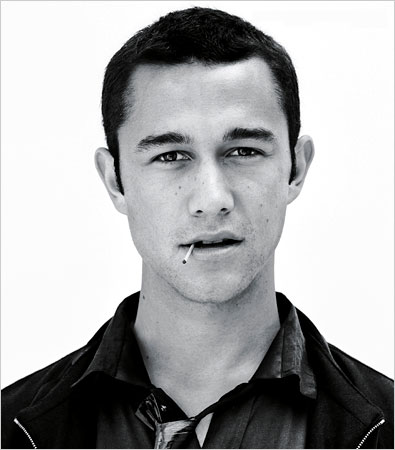
OK, one more movie post for the time being. I want it officially on the record, 5 or 10 years before anyone in the TV or film industry thinks of it: Joseph Gordon-Levitt for Steve Carella.


I have no idea why, but it suddenly struck me while I was watching the awesomeness that is 500 Days of Summer. "tall and rangy, with dark hair and brown eyes somewhat slanted to give him a slightly Oriental appearance", as McBain put it in Mischief. I mean, if Carella can be played by Donald Sutherland, Burt Reynolds, and Randy Flippin' Quaid... Plus there was that guy I couldn't be arsed looking up on the IMDb who was in Pet Sematary, who had the misfortune of playing opposite Joe Pantoliano as Meyer, an actual bald Meyer. If you're not a very good actor it's hard to play the lead when Joey Pants is supporting. But I digress.

Wednesday, October 7, 2009

Grandeur

This is mostly a Darwin post but we start with Ricky Gervais. Well, if you know that Gervais's new movie, The Invention of Lying, is out and that it involves his character being the first person in the world ever to tell a lie, and that (spoiler-ish alert) he ends up inventing religion, to comfort his dying mother then you can probably see where I'm going with this. It's a fun movie, although something of a disappointment in terms of its Hollywoodness, such as its relentless pursuit of a happy ending. It was co-written and -directed by Gervais and someone called Matthew Robinson (he has no other credits on IMDb); apparently it was originally Robinson's script so I'm curious as to what Gervais's input was. Certainly some scenes are much tighter than others - the ones where the love-story plot doesn't figure, basically - and the tightest of all is the ultra-fast scene with Stephen Merchant and, uh, Barry from EastEnders. But the scene where Gervais's character addresses the crowd with his information on the man in the sky is hilarious. Not every-word-perfect hilarious like Life of Brian, but it does some really neat skewering.

Which leads us to the skewer-wielder-in-chief, Richard Dawkins. His new book, The Greatest Show on Earth, is all about evolution. Not about God. In book terms at least, Dawkins has moved on, although not everyone has moved on with him. He was visibly frustrated on The Late Late Show when the whole God delusion thing was being rehashed. Science = boring; atheism = controversial = good telly, perhaps? Greatest Show isn't boring, though, providing as it does a sort of whistle-stop tour of the masses of evidence for evolution. There have of course been many books on the topic before, but Dawkins's name helps with the selling, and he is a very entertaining writer. He gets the occasional dig in, but I can't imagine the hardline God-botherers will be reading anyway (except to quote-mine, of course). He's very succinct on things like radioactive dating and continental drift, and his dismissal of the "gaps in the fossil record" argument is a good one: imagine a murder trial where there's no actual eyewitness but every other piece of evidence clearly points to the accused - until video footage emerges of the accused on his way to commit the crime, carrying the murder weapon, and his lawyer argues that the gap in the video record actually reduces the amount of evidence against his client! Hopefully there will be quite a few readers who don't know much about evolution but aren't happy with the biblical explanation, who will read this book and "get it".

And finally, Darwin himself, or rather Paul Bettany's version of him as conceptualized by a screenwriter and director. I was initially thrilled at the prospect of the film, not to mention the cheeky title Creation, but some aspects of the trailer had left me wondering whether there might be a bit too much Darwin-the-man and not enough Darwin-the-scientist, or, worse, that there might ultimately be some compromise (a deathbed conversion, even!) and (pace Huxley's "You've killed God, sir!") the deeper implications of his work might be fudged. I needn't have worried. The film does focus on Darwin the man, specifically the terrible impact his beloved daughter Annie's death had on him, causing him to delay writing Origin and sink into mental and physical collapse, while his wife Emma, a devout Christian, struggles in her own way. It's a well-structured screenplay, essentially telling two parallel stories - the "present day" as Darwin's peers urge him to write the book, and the past in which we see Annie and get the occasional discussion of Darwin's ideas. There's no single thorough going-over of evolution (I was kind of hankering after a JFK-style summation of all the evidence) but clearly that's not the film they wanted to make, and I think the piecemeal approach worked very well. One of the more memorable flashback scenes is a picnic at which Darwin talks with the vicar about Malthus, then we watch a time-lapse depiction of death and decay, as a bird falls from a nest, dies, and is consumed; this is followed by a church scene in which Darwin fails to join in with "All Things Bright and Beautiful", and walks out when the vicar begins sermonizing about God and the birds of the air etc. The two parallel strands reach their crises at the same time, in scenes of profound despair. (kind-of-spoiler alert) The climactic confrontation with Emma is blunt - she accuses him of not letting Annie stay in the grave, and he explodes with words to the effect that she's the one keeping Annie alive - on a cloud, with fairy wings. This, of course, is the deepest, and bleakest, implication of all. But the two parents recover from the crisis, and the film ends in hope. It's not often one gets to predict the last line of a film, but I guessed right. Really, there's only one way they could have ended it, with Darwin's voiceover:
There is grandeur in this view of life, with its several powers, having been originally breathed into a few forms or into one; and that, whilst this planet has gone cycling on according to the fixed law of gravity, from so simple a beginning endless forms most beautiful and most wonderful have been, and are being, evolved.

Tuesday, October 6, 2009

Yes, it's going to happen

So I had a long think and decided that, yes, there will be a third Nereffid's Guide Awards. Leaving aside the disillusionment with eMusic, the main difficulty with doing another was always going to be the amount of time I would have to put in. For two years I diligently filled a spreadsheet with every review from Gramophone, BBC Music Magazine, American Record Guide, Fanfare, Classics Today, MusicWeb, plus a handful of foreign-language sites. Even when I kept up to date it was something of a chore, and when I let it lapse for a few months at the beginning of this year, I found it impossible to get back to.
What's changed? I took a look at last year's spreadsheet and the winners and runners-up and realised that I don't have to keep track of every review - just the "very good" reviews. In other words, the Gramophone Editor's Choice and Recommends, the 5-star reviews in BBC Music, 9s and 10s from Classics Today, and so on. Only albums that get 4 such reviews are in with a chance. So that reduces by about 80 percent the number of albums I have to worry about. (Or thereabouts - I'm ditching the 3 foreign-language sites and brining in International Record Review and I'm not sure how this will impact exactly). So it's much easier for me to get the information in. Granted, at the end of the year I'll have a long list of contenders and I'll have to check all the publications for "not very good" reviews of these, but this shouldn't be too much of a hardship.
Also - and very significantly - the 2009 awards won't be confined to eMusic: they'll cover all new releases. In the long run that probably means less work than before, because I'd always been keying in every review anyway and I then had to spend a lot of time finding things on eMusic. I reckon there'll be about 3 to 4 times as many albums as before, which obviously means better overall quality, especially for the Opera category!
Why do I do all this? It's for my own benefit, ultimately. A key motivation to Nereffid's Guide and the awards was simply to encourage eMusic subscribers to tap into a marvellous resource, but the project never would have happened if I didn't think it would help me find great music. And so it is with what we might as well start abbreviating as NGA3, only this time the net's being cast a lot wider.

Sunday, October 4, 2009

Gramophone Awards 2009

And the winners are...
Of the 15 category winners, I have 3, which is about what I usually have - although of course it's a pretty meaningless number. The awards are quite meaningless to me on some level, too - my listening doesn't center around new releases, nor do I have a huge amount of interest in more recordings of repertoire I already own.
There should be a third Nereffid's Guide Awards, shouldn't there? I'd love to do it, and if I did it wouldn't be confined to eMusic any more. But I don't have any of the groundwork in place, so I doubt I'll be able to make time. I might try gathering some information this week. Watch this space!

Friday, October 2, 2009

This week I listened to

Barriere: Cello sonatas
Bruno Cocset; Les Basses Réunies
Alpha


Jean Barriere (c1705-1747) was "one of the finest cello virtuosos in France", according to Grove. In the 1730s he published 4 books of sonatas for cello with basso continuo, and this recording gives a sample of 6 sonatas. This is wonderful music, full of life and expressiveness, with plenty of opportunity for the cellist to show off. Right now I'm listening to a gorgeous Larghetto (Sonata no.6 from Book II). Another fine production from the small French label Alpha. Recommended to pretty much anyone.

Part: "In Principio"
Estonian Philharmonic Chamber Choir; Estonian National Symphony Orchestra/Tonu Kaljuste
ECM New Series

Quite a dark-hued album. In principio (setting the start of St John's Gospel) is closer to Philip Glass than I've ever heard from Part. La Sindone is the Shroud of Turin; obviously not a descriptive tone poem but a brooding orchestral meditation that builds to a huge climax. Cecilia, vergine romana is another quite dark one, concerned I suppose with the saint's martyrdom rather than her role as music's patron. This is now my third version of Da Pacem Domine (this choir also sang it for Paul Hillier on Harmonia Mundi); I think it's one of Part's finest works, a vast rolling ocean. The last 2 pieces are orchestra-only: Mein Weg churns along, while Fur Lennart in memoriam is a mostly warm and gentle piece. As a whole, the album isn't the best of introductions to Part's music, but it's an excellent release nonetheless.

Ewazen: Orchestral music and concertos
various soloists; Czech Philharmonic Chamber Orchestra/Paul Polivnick
Albany


I'd never heard of Ewazen until I happened to come across him on eMusic a couple of years ago. From the samples he struck me as a composer worth getting to know, but I didn't do anything about it until he appeared on the cover of a recent Fanfare. In the interview, Ewazen spent some time discussing the works on this particular album, so I decided this would make for a good introduction, and it certainly is. Ewazen says that in his tenor sax concerto he wanted to capture the nature of Prokofiev's "Classical" symphony, while in the Chamber Symphony he was aiming for a Brandenburg no.5 deal with a notable contribution from the piano. There's also a flute concerto and a Ballade for clarinet and orchestra. The cover of Fanfare uses the words "Appealing, enthusiastic, a melodic gift, a joy...", which is spot on.

Beethoven: Bagatelles
Linda Nicholson
Accent


The lighter side of Ludwig, here played on a lovely-sounding fortepiano. If you like fortepianos, that is. Those who insist that Beethoven was actually composing for a modern grand will probably be horrified, especially on those occasions when a string will twang like a sitar. Personally, I love it - I have no problems with a good fortepiano for Beethoven, and I think it's very much apropos for pieces like these. Linda Nicholson seems to have particular fun with Rage over a lost penny, a piece I think should be much better known, and she manages to blow the dust off Fur Elise too.

Shostakovich: The Nose
soloists, orchestra and chorus of the Mariinsky Theatre/Valery Gergiev
Mariinsky


Based on a short story by Gogol, in which an official's nose disappears, prompting a search through St Petersburg. Shostakovich wrote this opera when he was 22, and it makes you pause and think what his composing career might have been like if Stalin hadn't intervened a few years later - Shostakovich's only other opera was Lady Macbeth of Mtsensk. As you might expect given the nature of the story, this is crazy stuff, one of its more notable features being a 3-minute solo-percussion interlude. There's close to 100 separate roles - although most of them get a few lines at best. It's not often you see such effort being put into triviality! It's all great fun (assuming you have the libretto, obviously).

Listy Duverne

This talk of non-translation also reminds me that a couple of days ago I saw for the first time Janacek's String quartet no.2 referred to by its Czech title, "Listy duverne", rather than the English "Intimate letters".
I don't know, surely Listy DuVerne is a saloon singer, possibly played by Mae West?

Gardaí win Ig Nobel Literature Prize

This year's Ig Nobel Prize winners include

Ireland's police service (An Garda Siochana), for writing and presenting more than fifty traffic tickets to the most frequent driving offender in the country — Prawo Jazdy — whose name in Polish means "Driving License".
That reminds me of when I was working for the county council and came across some correspondence with a UK environmental monitoring firm (for the sake of argument). The County Secretary had written to them and had, as was normal practice, signed the letter with his title, "Runaí Chonndae", typed underneath. Inevitably, the reply came back: "Dear Mr. Chonndae..."